
The 10 Nuevos Soles (PEN) notes released between 1991 – 2020 bear José Abelardo Quiñones Gonzáles (1914 – 1941), on the obverse.
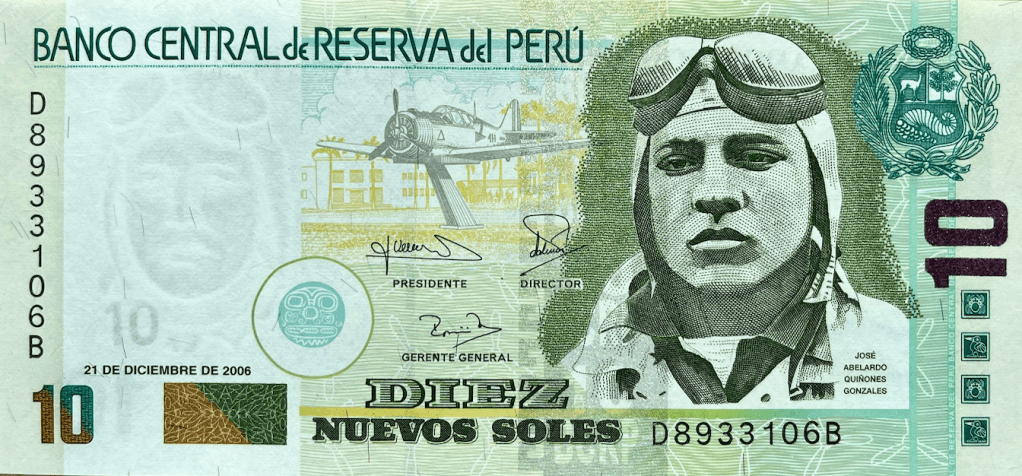
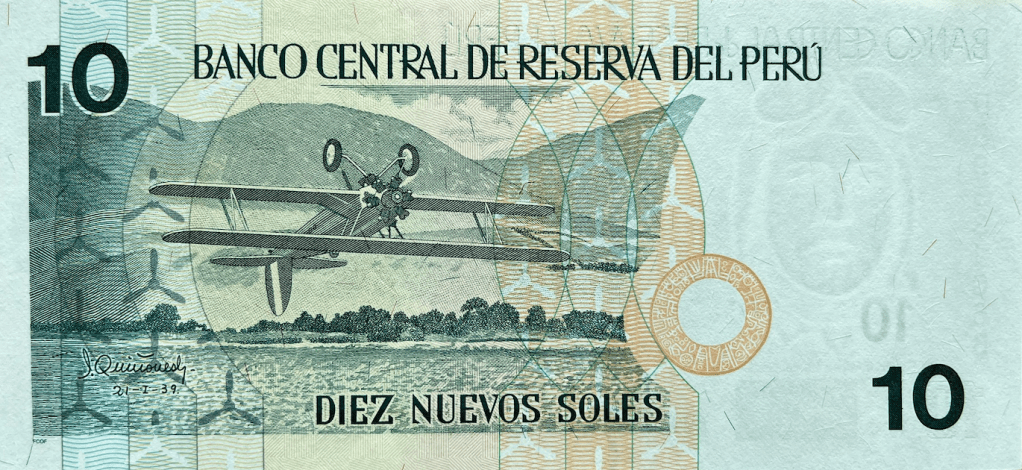
José was a Peruvian military aviator who became a national hero. He joined the Peruvian Air Force in 1935 despite his parents’ opposition and rapidly developed great flying skills that set him apart from his peers. Known for his aerial acrobatics, he performed a memorable maneuver on the day of his graduation from aviation school, flying his plane (a Caproni 113), inverted less than two meters above ground. This scene is depicted on the reverse of the 2006 Series note shown below.
In addition to the 10 Nuevos Soles note, the smallest denomination of the 1990 – 2021 Soles series, the Central Reserve Bank of Peru also released notes in the 20, 50, 100 and 200 denominations. All notes are of equal size (140 x 65mm), and are made from cotton materials.
As a Lieutenant with the 41st Squadron in the Peruvian Air Force, José Abelardo Quiñones Gonzáles served in a bombing attack of Ecuadorian forces on July 23, 1941. With his aircraft critically damaged (an American NA-50 dubbed “TORITO” or Little Bull), he sacrificed his life by intentionally flying his plane into enemy positions. He was posthumously promoted to the rank of Air Force Captain and was also rendered a national hero by law on May 10, 1966.
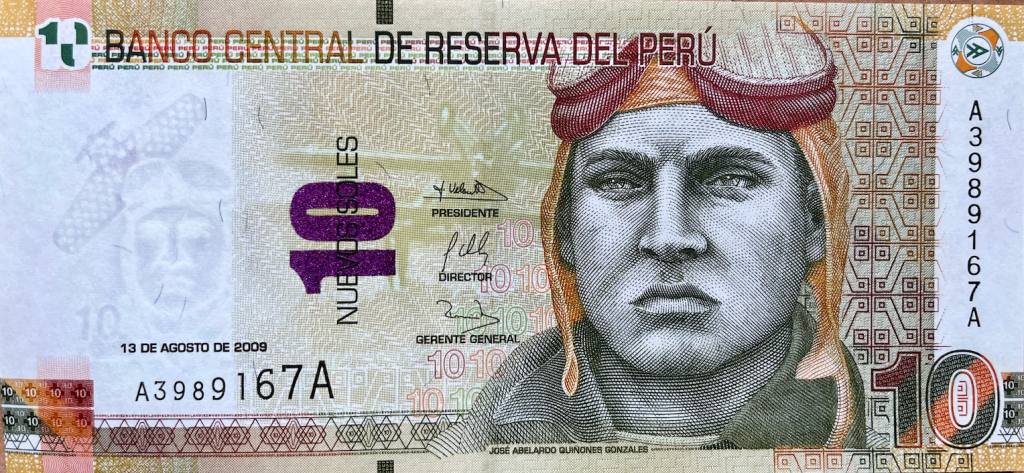
The 2009 series 10 Nuevos Soles note also depicts José Abelardo Quiñones Gonzáles on its obverse however bears a different motif on the reverse.
The reverse is dedicated to one of the seven wonders of the modern world, Machu Picchu, the 15th century Inca citadel located in the mountainous Eastern Cordillera in southern Perú at an altitude of 2,430 meters. “The Lost City of the Incas” as it’s often dubbed, Machu Picchu (or “old mountain” as translated from Quechua, the Inca language), is believed to have been built around 1450 as part of a royal retreat. The citadel was in use for about 80 years before being abandoned, as some speculate due to Spanish conquest of the Inca empire during that time frame. Over the ensuing centuries Machu Picchu became lost in time until its “rediscovery” in 1912 by American explorer Hiram Bingham III. Today Machu Picchu is Peru’s most visited destination with 1.5 million people ascending upon it annually.

Both of these notes posses similar security features including the prominent water mark depicting José Abelardo Quiñones Gonzáles and a vertical security thread in form of a plastic strip with the inscription “PERU 10” visible when the notes are help up to the light. The word “PERU” is also seen repeatedly within the number 10 on the lower left corner on the 2006 Series note, and the same phenomenon is repeated on the 2009 Series note within the number 10 (on its obverse and reverse). Underneath the BANCO CENTRAL de RESERVA del PERÚ inscription, there is a line that bears the same inscription repeatedly on the 2006 Series note while on the 2009 Series note, the word PERU is visible numerous times within the plain of the BANCO CENTRAL de RESERVA del PERÚ inscription. These subtle security features are best viewed with the help of a magnifying lens. Red and blue fibers are also noticeable on both side of both notes.
The 10 Nuevos Soles notes of the 2006 and 2009 series are legal tender today although a newer series was introduced in 2016 that dropped the word “Nuevos” curtailing the name of the currency to just Soles. Then on July 22, 2021, a new 10 Soles note was introduced which no longer depicts José Abelardo Quiñones Gonzáles. All of these versions of the note are running concurrently in circulation today.
My Two Cents
It is interesting to observe the evolution of the 10 Soles Peruvian note over its lifetime, from subtle design changes to more drastic ones like changing the person featured on the bill. Sol translates to “Sun” from Spanish and Soles have been Peru’s currency since 1863, replaced for a brief period (between 1985 – 1991), by the Inti. Inti in the Inca religion was the sun god.

 The Paper Money Guy
2 responses to “10 Nuevos Soles Peru: Soaring to New Heights”
Hey Alex,
What a very precise description of the bank note. Interesting. It sure took you a lot of time to write it. Do you intend to do it with all of them or just the more interesting ones? Cause you have a bunch of them, don’t you? Anyway keep on making us travelling around the world with you stories.
L.
LikeLiked by 1 person
Hey L,
Thank you for the kind feedback! Time flies when you’re having fun, so I hear. The idea is to go one step at a time and see how it unfolds. Happy to hear you are enjoying the journey. Hang with it and we’ll travel all around! 😉 Thanks again!
LikeLike