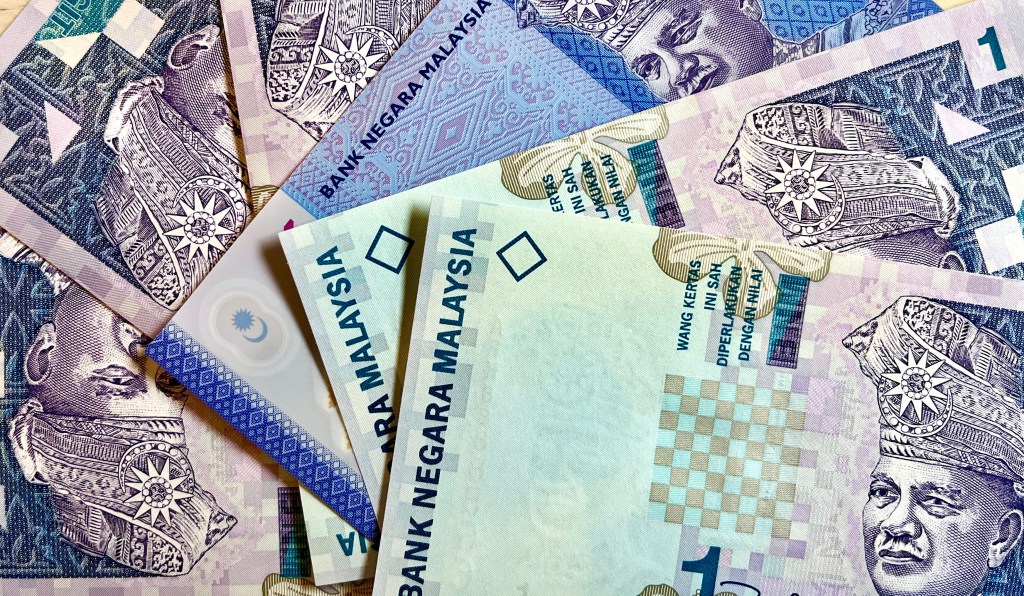
The Ringgit (MYR), is the official currency of Malaysia. Its name translates to “serrated edge” and was used to refer to Spanish coins with characteristic jagged edges that circulated in the Philippines some 200+ years ago. The term “ringgit” has been around for centuries. It became the national currency in 1967 as it replaced the Malaysian Dollar. Today, the Central Bank of Malaysia issues ringgit in the following denomination: 1, 5, 10, 20, 50 and 100. The 1 and 5 are polymer notes. The other denominations are made of paper material and ascend in size as they ascend in denomination. Since the inception of the central bank, four series of banknotes have been issued, the most recent being in 2012. Interesting fact: from 1967 to 1973, the currencies of Malaysia, Singapore, and Brunei were interchangeable. They had a 1:1 exchange rate. This was based on the Interchangeability Agreement established between the three independent nations. Although Malaysia had pulled out of the pact in 1973, the agreement is still in place today between Singapore and Brunei.

Obverse (Third Series 1996)
The 1 Ringgit Third Series note is made of paper material. It is the smallest sized note in the series, measuring 120 x 65 mm. The central figure depicted on the note is Tuanku Abdul Rahman (1895 – 1960). He was the first Constitutional Monarch. He was also the Head of State of newly independent Malaysia after it broke from British rule in 1957. He is featured in traditional royal garb along with headgear bearing the 11-point royal star. Tuanku Abdul Rahman was elected to this position for a 5-year term however he died in 1960, about two years shy of completing it. Prior to becoming head of state, he was the ruler of Negeri Sembilan, a Malaysian province, for 24 years. As part of his legacy, he is portrayed on banknotes of all series issued by the central bank. This has been the case since 1967 to present day.
There is a watermark featuring Tuanku Abdul Rahman on the left panel, visible when the note is held up to the light. The denomination is listed in two locations, within the bottom center and top right corner. The checkered pattern at the note’s center is part of a slew of security icons. These icons interact with UV lighting to authenticate the note. The numeral “1” becomes apparent when the note is held horizontally, gently tilting it toward and away the light source.
Reverse
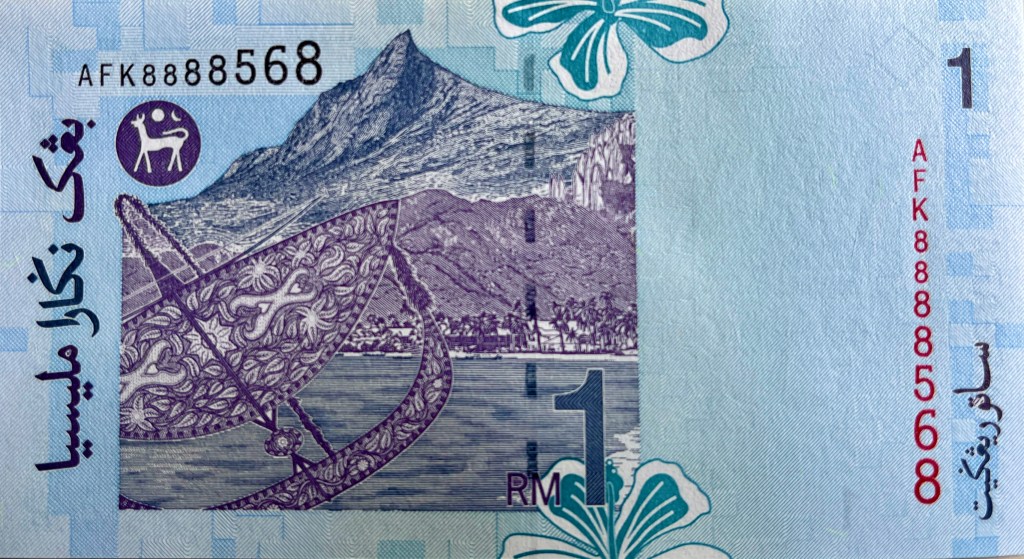
The vignette depicted on the note’s reverse shows natural landscapes with Mount Kinabalu and Mount Mulu. It also includes a Moon-Kite (Wau Bulan), a Malaysian cultural icon. Kinabalu is the highest mountain in Malaysia and Borneo at 4,095 meters. Borneo is the third largest island in the world and is divided among the nations of Malaysia, Brunei, and Indonesia. Kinabalu is a protected World Heritage Site. Next is Mount Mulu, which summits at 2,376 meters. It is the second tallest mountain in the Sarawak province of Malaysia, and home to many unique and endangered plants and animals that inhabit its secluded peaks. The floral motif moon-kite is a national symbol and is made from bamboo and paper. Hibiscus flowers are observed on this side of the note as well.
The serial number appears in two locations. It is printed in black and red ink. Ascending characters are in horizontal orientation in one location. In the other location, the characters are in vertical orientation. On the left panel, the National Bank of Malaysia is depicted in Jawi script, a local script based on the Arabic alphabet. A thin windowed security strip running vertically is seen at the center of the note.
Obverse (Fourth Series 2012)
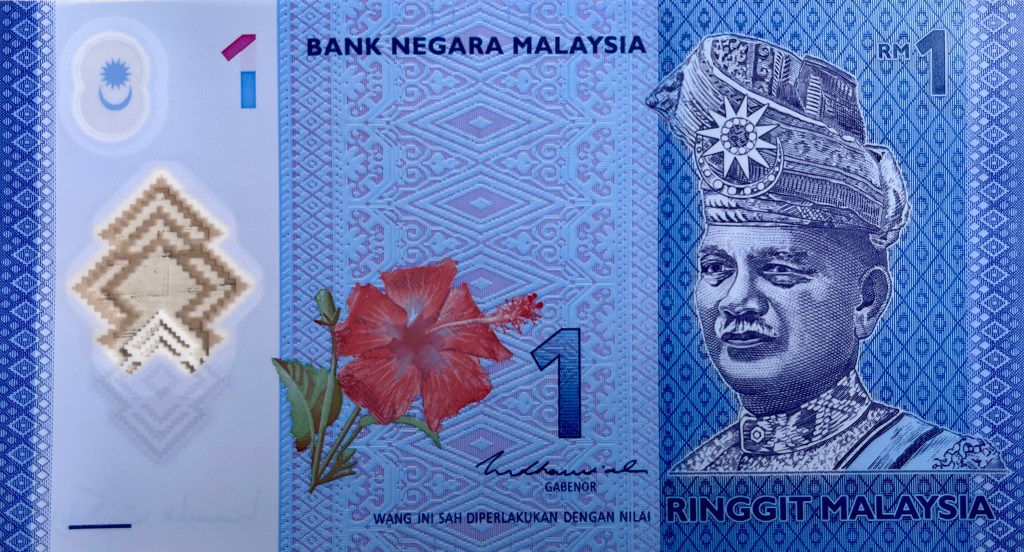
The Fourth Series 1 Ringgit note announces itself as a spectacle of color and patterns with pronounced hues of blue. This note is a polymer. It supports the vibrancy of color and other noticeable features. These include the transparent windows within the left panel comprising the crescent and royal star. Additionally, there is the triangular decorative woven pattern known as a “songket”, a pattern typical of Malaysia, Indonesia, and Brunei. Within the middle panel, additional woven patterns are observed. A red hibiscus, the national flower of Malaysia, is also present alongside the note’s denomination. To the right, Tuanku Abdul Rahman’ portrait is displayed in the same manner as on the third series. The 1 Ringgit notes of the third and fourth series are equal in size and both are legal tender.

Reverse
The backside reveals a rectangular window depicting a few moon kites against a beach vignette. The woven patterns from the note’s obverse are consistent on the reverse as well. The serial number is listed in red and black ink in two locations. The symbol of the Central Bank of Malaysia, a mouse deer, appears in the upper left corner just above the red serial number. Jawi script is seen here as well standing for Central Bank of Malaysia and Malaysia Ringgit.
My Two Cents
The Malaysian Ringgit has had an interesting history. It was once linked on parity to the Singapore and Brunei dollar. Over several decades, it experienced several waves of devaluation primarily against the US dollar. The name itself represents a foreign entity. Its legacy continues to persist today in Southeast Asia, hundreds of years after its first appearance. The Ringgit highlights the nation’s strong ties to the royal families who served as rulers of the country. An example is Tuanku Abdul Rahman’s portrait. He is depicted on all notes issued throughout the central bank’s history.
The shift to issuing more denominations as polymers is a signal towards a wider adoption of such currency. Interestingly, the current series instated the 20 Ringgit denomination but also removed the 2 Ringgit. One can only wonder which denominations will be included in the next series. Will we see even more polymer denominations come to life? Time will tell!

 The Paper Money Guy