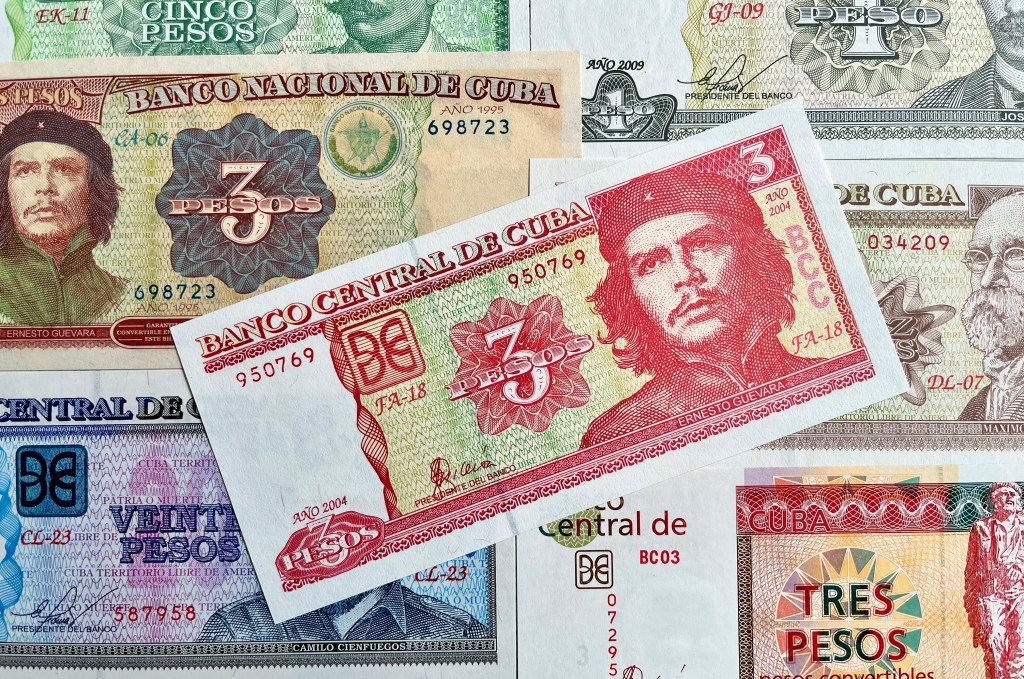
The Peso (CUP), is Cuba’s national currency and has been circulating within the island nation since 1857 in various forms. Cuba, like many other Caribbean islands and nearby Central American nations have indelible links to Spain manifested in culture, language and monetary policy. As a result, the Peso is quite ubiquitous within the Latin world and Cuba’s version bears a unique and interesting history.
Today, the Central Bank of Cuba (established in 1997), is the issuing authority of pesos which exist in the following denominations: 1, 3, 5, 10, 20, 50, 100, 200, 500 and 1,000. All are equal in size (150 x 70 mm), and are constructed of paper material. As such, Cuba ranks at the top in the number of different banknote denominations issued (particularly among countries without hyper-inflation). The 3 Peso banknote is a largely uncommon denomination shared by only a couple of other countries (The Bahamas and Cook Islands).
January 1, 2021 marked an important date on Cuba’s monetary policy calendar and became known as “Day Zero”, or the day Cuba’s dual currency system was eradicated and the nation reverted back to one official currency. To understand this system, we’ll rewind to 1994, when the government introduced a secondary peso, the Convertible Peso (CUC), as a way to stabilize the economy. The CUC was pegged to the US dollar in a 1:1 ratio and was intended to eventually lessen the dependence on US dollars which circulated in Cuba alongside the existing peso (CUP). A dual economic system was therefore created dependent on pesos, one that catered to tourism and international transactions (utilizing the convertible peso), and another for local commerce supported by the regular peso. One CUC or convertible peso was equal to 25 CUP or regular pesos.
As of July 21, 2021 the convertible peso (CUC), became obsolete and was no longer issued or accepted by businesses. Thus, the Cuban peso (CUP), prevailed as the sole currency of the nation. One of the telling differences between the regular and convertible pesos are the subjects they feature; portraits of various political, cultural and intellectual figures are seen regular pesos whereas statues of these very figures adorn the convertible pesos. One such figure is Ernesto Guevara, or more commonly known as “Che Guevara” or simply “El Che” who appears on the 3 denomination notes, the main subject of this post.
Series 1995 CUP – Obverse

The face of the 1995 Series 3 Peso depicts Ernesto Guevara (1928 – 1967), in his signature green military fatigues and a black beret dotted by the communist star. Guevara is one of the most recognizable icons of revolution (and guerrilla warfare), for the role he played in the Cuban Revolution in the face of imperialism and western (primarily US), influence. Originally from Argentina, El Che was trained as a physician and spent time traveling around much of Latin America where he witnesses firsthand the far reaches of poverty and hunger, and what he perceived as the injustices of the grip of capitalism over Latin America. Taking to Marxist ideals and fueled by his experiences while traveling, he devoted his life to fighting against capitalism and played a key role in overthrowing the US backed Cuban presidency, alongside his comrade in arms Fidel Castro, in 1959. As a new unilateral socialist government was formed post revolution, El Che served in various functions including President of the National Bank of Cuba. Interesting fact: during his tenure as president his signature on notes bore his nickname “Che” as opposed to his legal name.
The note’s 3 denomination is seen at the center along with the coat of arms of the National Bank of Cuba to its right. The serial number is listed in two locations in dark blue ink. Within the background design, the micro inscription “PATRIA O MUERTE TERRITORIO LIBRE DE AMERICA” is observed (translating to “Country or Death Free Territory of America”). The text at the bottom center refers to the note being exchangeable for its face value in gold as an obligation of the Cuban State, a claim that would eventually disappear with the subsequent series.
Reverse
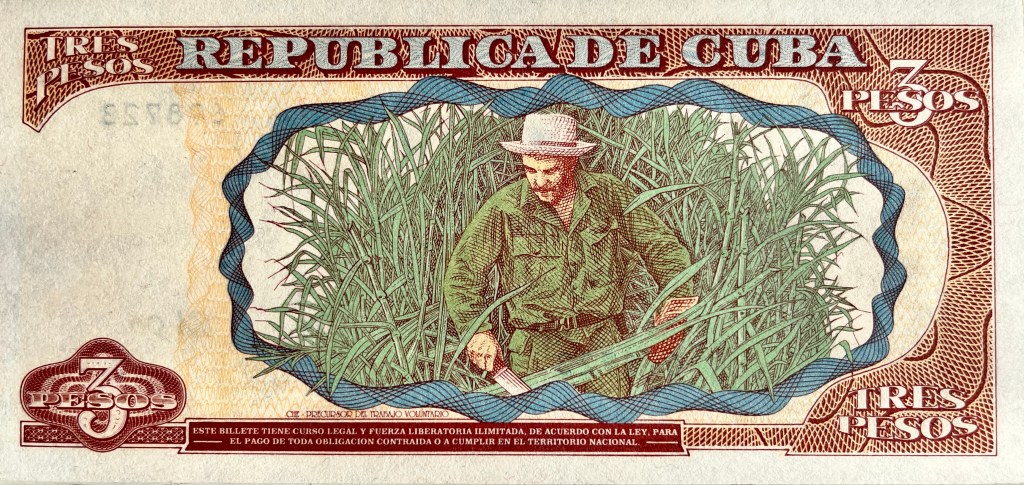
The vignette on the reverse features Che Guevara working on a sugar cane field, an activity he took up on his days off. Core to his beliefs was that volunteering was important to wellness of the state and that all citizens should volunteer in some capacity. The note’s denomination is visible in all corners in alphanumerical format. Aside from the intricate design on both sides of the note and the watermark, the note is quite light in other security features.
Series 2004 CUP – Obverse
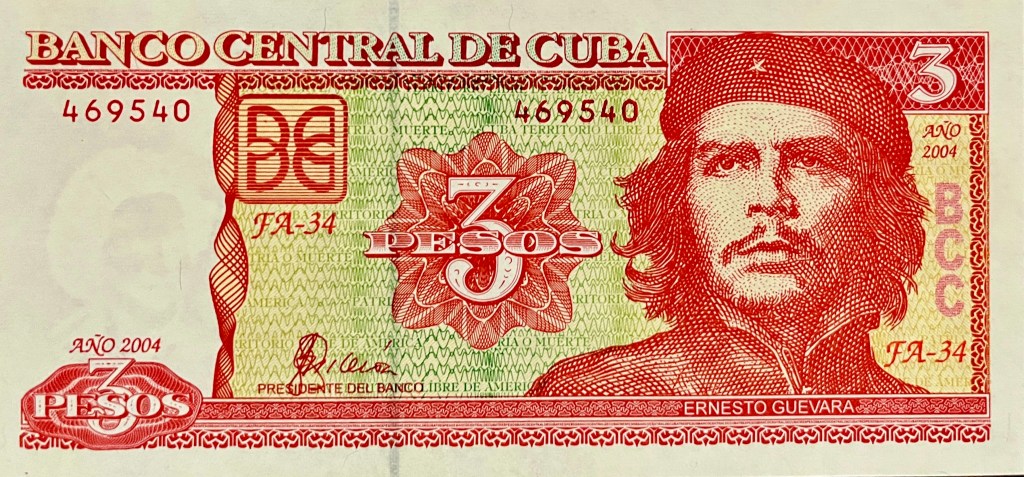
The bright red face of this series reflects a patriotic Che Guevara on the right and a watermark of Célia Sánchez Manduley (Cuban revolutionary, and politician), on the left panel. Similar to the previous series, the central design featuring the denomination is almost identical. However the similarities end there as this note bears the markings of an arguably more vibrant and alive specimen. The issuing authority can be seen as the Banco Central de Cuba (Central Bank of Cuba), while the serial number is listed in red ink in two locations. The bank’s symbol (seen just under the world “CENTRAL”), also differs from that of its predecessor.
Reverse

The reverse of the 2004 series bears the same vignette as the 1995 note. A security thread runs north – south through the sugar cane field. The back is quite minimalist in tone, observed in the use of only three main colors (red, white and light yellow).
Convertible Series 2007 CUC – Obverse
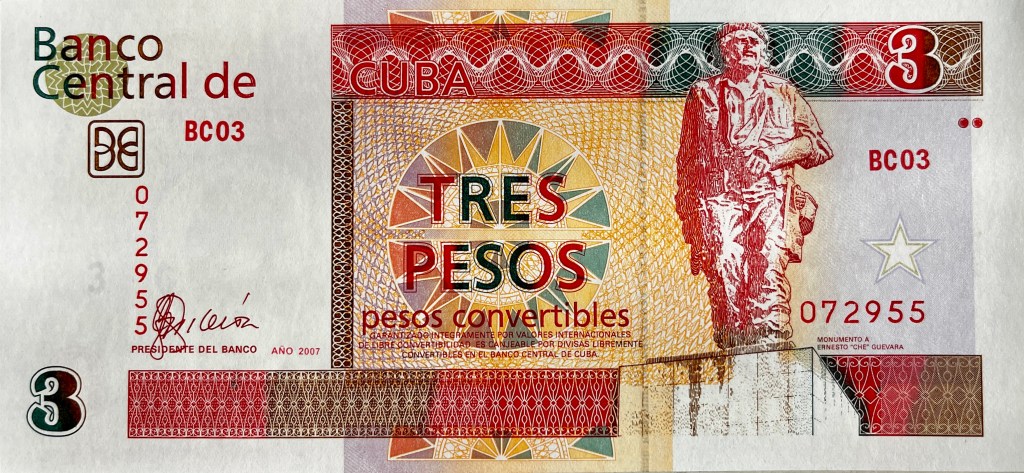
The Convertible Peso circulated between 1994 – 2021 and was issued by two authorities, the National Bank and Central Bank of Cuba. The face of the note features the Che Guevara Monument, part of the Mausoleum located in Santa Clara, Cuba. The denomination is listed at center and just underneath is an inscription indicating that the note is exchangeable for international securities (or currencies), at the Central Bank of Cuba. A watermark of José Martí (Cuban nationalist poet and philosopher), is located on the left panel. The serial number is listed in red ink in two locations, running in vertical and horizontal orientation. The Banco Central de Cuba inscription occupies the top left corner and just underneath is its logo. To the right of Che, is Cuba’s 5-point star which symbolizes freedom. A security thread is seen to Che’s left bearing the “PATRIA O MUERTE – VENCEREMOS” inscription, which became Cuba’s national motto in 1960. “Venceremos” translates to “we will win”. The two red dots in the upper right corner are designated for the visually impaired to discern the denomination.
Reverse
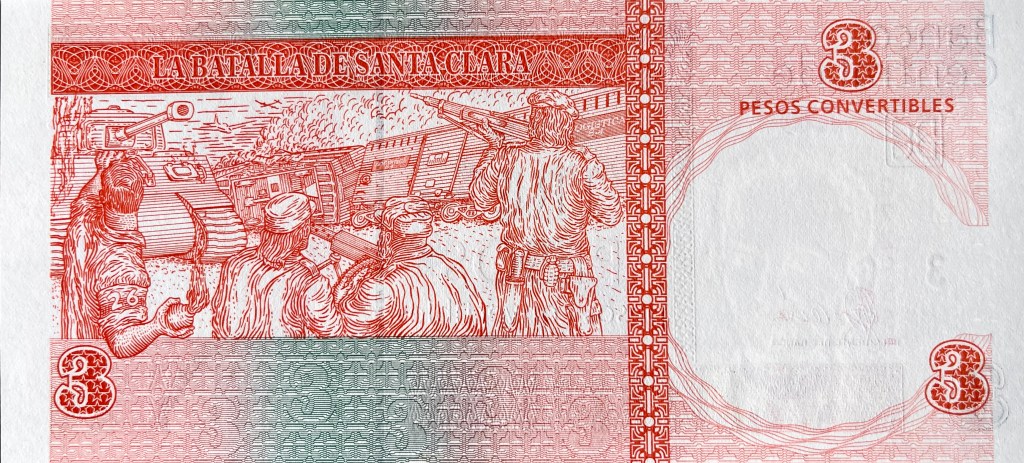
The back of the note strikes a different tone compared to regular 3 Peso, depicting a scene from the decisive Battle of Santa Clara in 1958, in which revolutionaries led by Che Guevara had taken the city. A tank and an armored train that carried Cuban army troops and armaments is shown as derailed. The battle proved pivotal and contributed to the subsequent success of the revolution. Underneath the battle scene, the note’s “3” is seen repeatedly as part of the background design. On the right panel, the watermark is hailed by an additional two “3s”.
My Two Cents
There is no shortage of interesting historical facts associated with Cuban Pesos, originating with former colonial power Spain, to coming under the influence of the United States, followed by none other than the polarized orbit of the Soviet Union. If only these pesos could speak! To understand Cuba’s peso is to delve into centuries of history, political philosophies, imperial tendencies, that ultimately shaped not only Cuba’s national identity but the course of history on a global scale. As a result, one stark factor continuing to impact the Cuban Peso (and Cuba alike), to this day, is the US embargo levied upon the island nation (for political reasons), since 1958. It becomes easier then to appreciate the symbolism and iconography depicted on Cuba’s currency, starting with the 3 Peso note and the tale of revolutionary hero Che Guevara.
The 3 Peso is as much an anomaly in the numismatic world due to its unique denomination, as is Cuba’s national identity and political ideology (as a socialist republic led by a single party defined as communist), within the western hemisphere’s sea of capitalist sovereignties. Politics aside, the note is a window into the country’s history, culture and political construct, and surfaces a national symbol (in El Che), who even served as an important figure within Cuba’s banking system. Notes bearing his signature are highly valued and sought after by collectors. Should dreams come true, I’ll one day have a Che-signed note lead the charge among my collection.

 The Paper Money Guy
3 responses to “A Revolutionary Bill and Figure: Cuba’s 3 Peso Note”
Wow! This is so interesting! I can‘t believe it.
LikeLiked by 1 person
Interesting Alex! It looks like you need to make a trip to Cuba to check this out…
LikeLiked by 1 person
That would be nice!
LikeLike