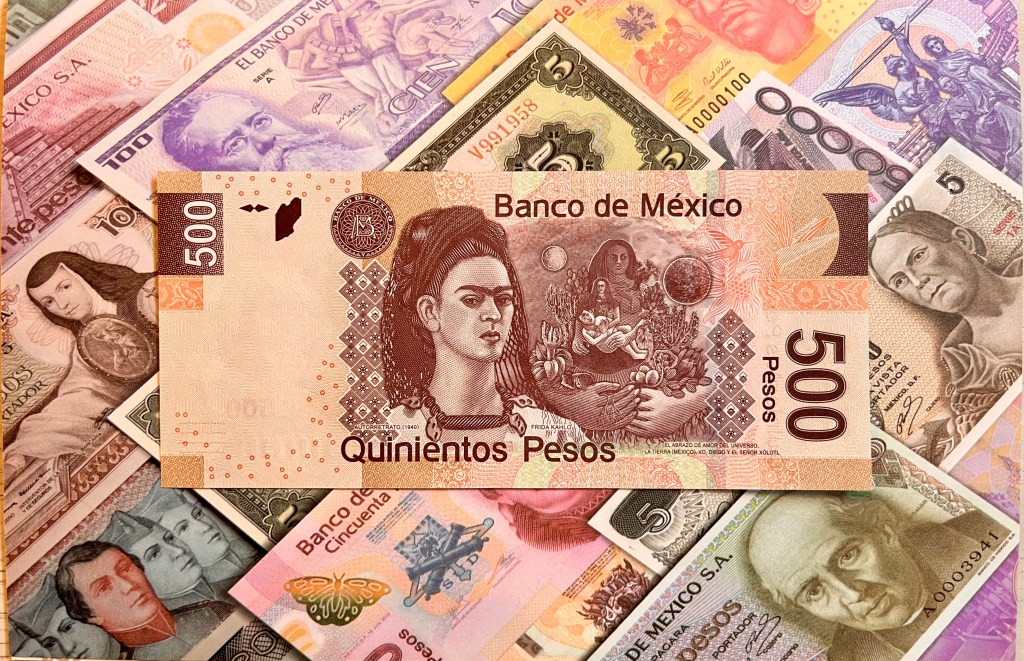
The art world was abuzz recently. Two famous paintings sold at auctions, fetching record prices. One sold for $236.4 million and the other for $54.7 million. One was by Gustav Klimt, a European artist, and the other by female Mexican artist, Frida Kahlo.
Kahlo is the inspiration behind this post. Her self-portrait, The Dream (The Bed), set multiple records. It achieved the top price for a female artist. It also recorded the top price for a Latin American artist.
Magdalena Carmen Frida Kahlo y Calderón (1907 – 1954), was a Mexican painter. She was known for her vibrant self-portraits that manifest Mexican culture. Her work also deeply reflects her personal experiences. Art came to her when she a young child and so did polio, unfortunately. Both impacted the rest of her life. Their influence became evident not only in her artistic self-expression but also in her personal appearance.
At 18 she suffered yet another blow, she was involved in a severe bus accident that caused lifelong debilitation. Throughout her subsequent years physical and emotional pain afflicted her, becoming central themes in her paintings. Despite these challenges, she flourished as an artist, depicting a unique style connected to Mexican folklore, surrealism, and magical realism.
Frida Kahlo was married to renowned Mexican muralist Diego Rivera. She divorced him at one point, only to remarry him shortly after. When she was alive, her work and reputation was often eclipsed by that of Rivera. After her untimely death at 47 however, her reputation far surpassed that of her husband. She left behind a multifaceted legacy, artist, feminist, culturalist, icon!
Mexico 500 Pesos (2010)
The 500 Pesos Series F (or Type-F) Note, pays tribute to Frida Kahlo and Diego Rivera. The note was introduced in 2010 by Banco de Mexico. It was the second largest denomination in that series behind the 1,000. The other denominations were: 20, 50, 100 and 200. The note measures 148 x 66 cm, and is second largest in size after the 1,000. It is constructed from cotton material. The bill is still in circulation despite a subsequent G Series having been introduced in 2018. Kahlo and Rivera are not depicted on any of the banknotes in that series.
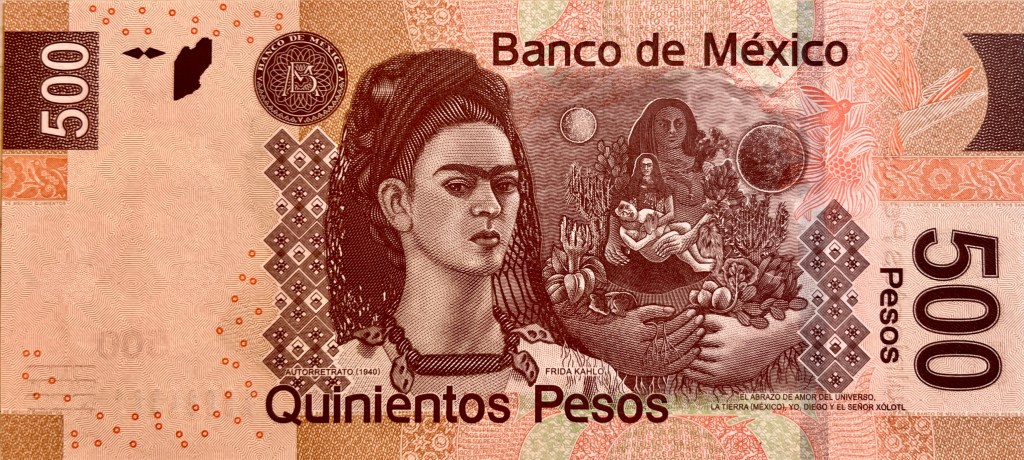
Reverse
A self-portrait of Frida Kahlo from 1940 takes main stage on the note’s reverse. To the right is her 1949 painting, The Love Embrace of the Universe, the Earth (Mexico), Myself, Diego, and Señor Xolotl. The Banco de Mexico official emblem is located just above Kahlo’s head to her left. The 500 denomination appears twice in opposing corners.
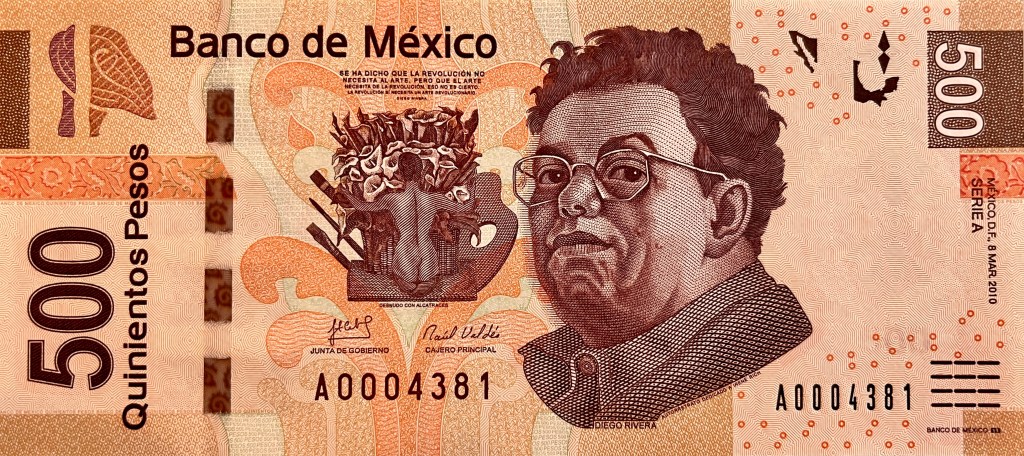
Obverse
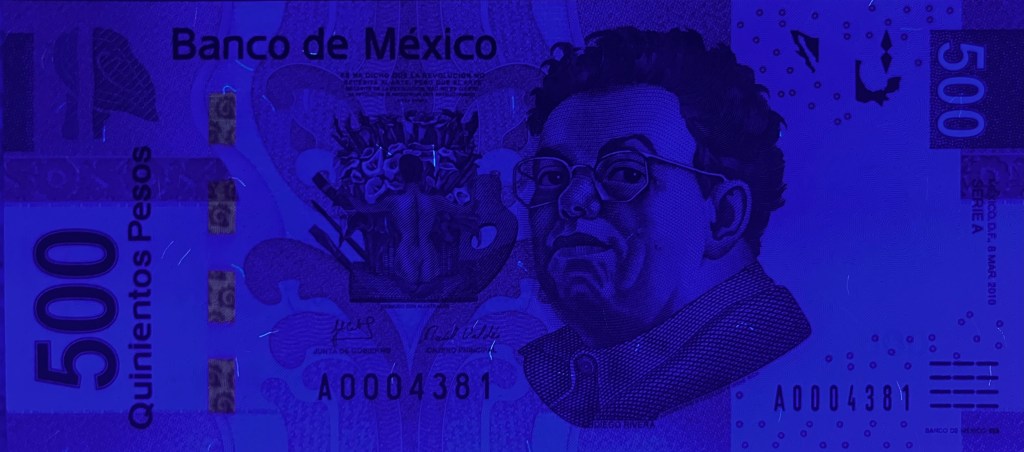
The front depicts a self-portrait of Diego Rivera from 1941. One of his works, Nude with Calla is seen to his left along with this quote: “It has been said that the revolution does not need art, but that art needs the revolution. That is not true. The revolution does need revolutionary art.” A watermark of Rivera occupies the right panel. The serial number is listed twice in different colors, maroon and black. The Junta de Gobierno (Governing Body) and the Cajero Principal (Head Cashier) signatures are seen above the maroon serial number.
On the left panel is the note’s denomination. A holographic segmented 3D security thread runs north-south just left of Rivera’s painting. In the top left corner is a paint brush with color shifting properties. Within the top right corner is a perfect register, a security feature with impressions on both sides of the note. These impressions come together to complete the object when the note is held to the light. Micro printing is also present on both faces as another security attribute. For the visually impaired, the four horizontal segmented lines raised for tactile impact, help distinguish its value.
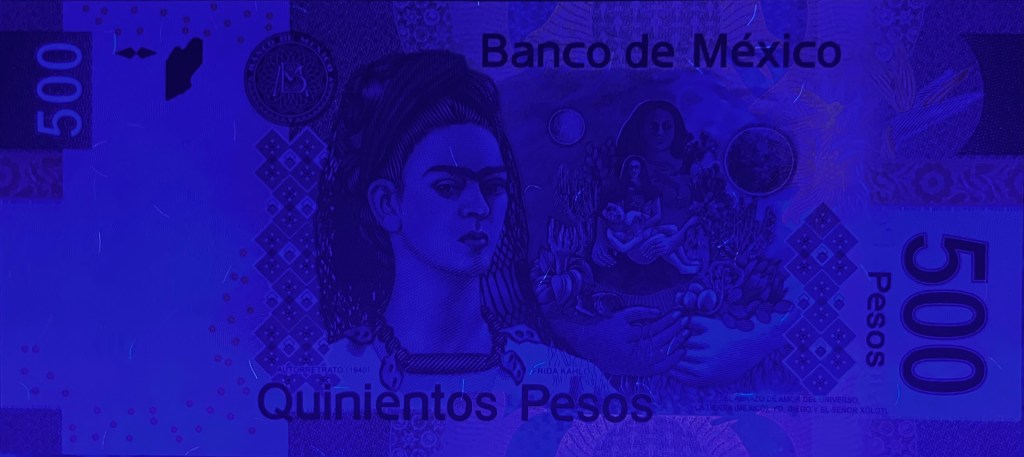
UV Light Exposure
My Two Cents
Frida Kahlo’s life was complicated. Her marriage to Diego Rivera was complicated. The 500 Peso note is arguably complicated as well. Part of me wishes the note was exclusively dedicated to Kahlo. Perhaps Rivera could have featured on a different note or coin, given the couple’s tumultuous relationship. The shared spotlight is not doing it for me but I can understand the why. Perhaps there could be no Kahlo without Rivera and no Rivera without Kahlo. They complemented each other, as artists, as partners, as enigmas.
This 500 Pesos binds them in perpetuity. In doing so, the note blurs the line between a typical obverse and a typical reverse. It seemingly has two faces, or perhaps a face and its shadow. Was this unconventional design meant to drive the conversation and note’s interpretation? Perhaps the answer here too is somewhat complicated.

 The Paper Money Guy