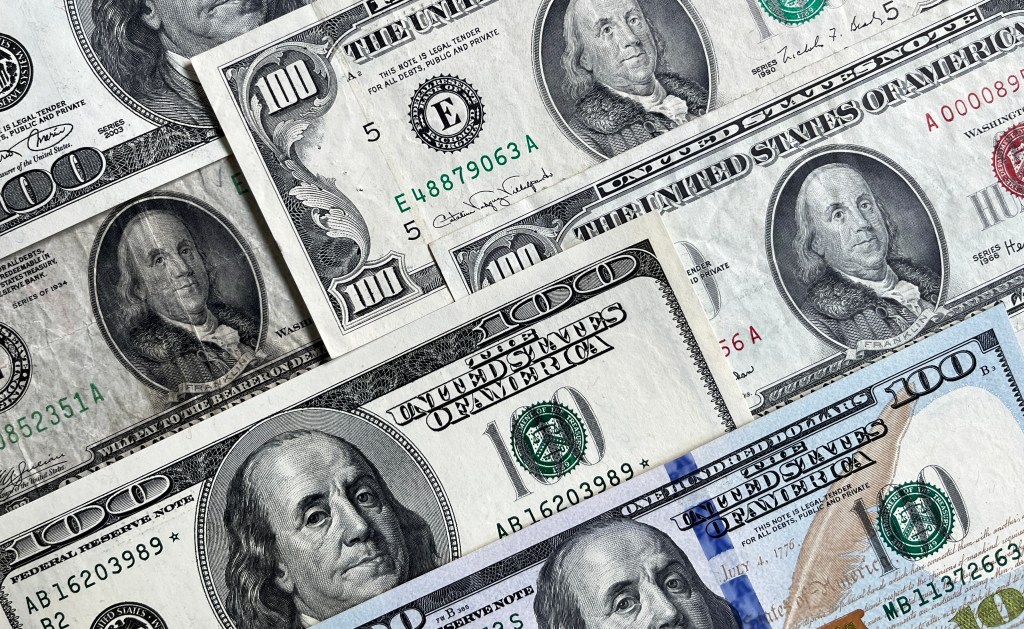
The US $100 banknote, commonly known as a “C-Note,” is a global icon. It stands out not only in the world of currency but culturally as well. The US dollar serves as the world’s reserve currency. Due to this status, the $100 is a symbol of power, success, and financial stability. Arguably it can also be perceived as a symbol of corruption, criminal activity and greed. Many people can identify with scenes from films of briefcases full of $100 bills, making for quite the mental imprint. More often than not, such scenes are linked to some type of illicit activity or bad guys in the plot.
In the real world however, $100 notes or “Benjamins” serve numerous purposes good and bad, domestically and abroad. According to the Federal Reserve Bank of Chicago, up to 80% of all C-Notes are outside of the United States. This is a testament to the power and stabilizing effect of the US dollar. In 1969, the $100 became the highest denomination of all US notes. At that point, the $500, $1,000, $5,000, and $10,000 notes were pulled from circulation. It is also the second most printed after the $1 note, and has the longest lifespan at an estimated 15 years, due mainly to infrequent use. Another common phenomenon (more so a nuisance), associated with the $100 is its lack of acceptance in everyday commercial transactions. Many shop owners, vending machines and other places of commerce are explicit about not accepting $100 bills. Among the most common reasons for this, are counterfeiting and lack of change. Abroad, the $100 note is in fact the most counterfeited. In the United States, the $20 bill holds that distinction. As a collector, I would love to add a counterfeit $100 note to my collection. Unfortunately, it is illegal to knowingly possess counterfeit bills.
A Bit of History
The first US $100 note was introduced in 1862. It has been revised several times since with changes not only in appearance but also in size. In this post, we’ll take a look at different $100 notes issued over the past 90 years. Since its introduction, the $100 circulated as various note types, including United States Notes, Gold Certificates, and National Banknotes. The specific note type is dependent upon the issuing authority.
In 1914, the first Federal Reserve $100 Note was introduced bearing the portrait of Founding Father Benjamin Franklin. Today, all US dollars issued are Federal Reserve Notes and the latest series for the $100 is 2021.
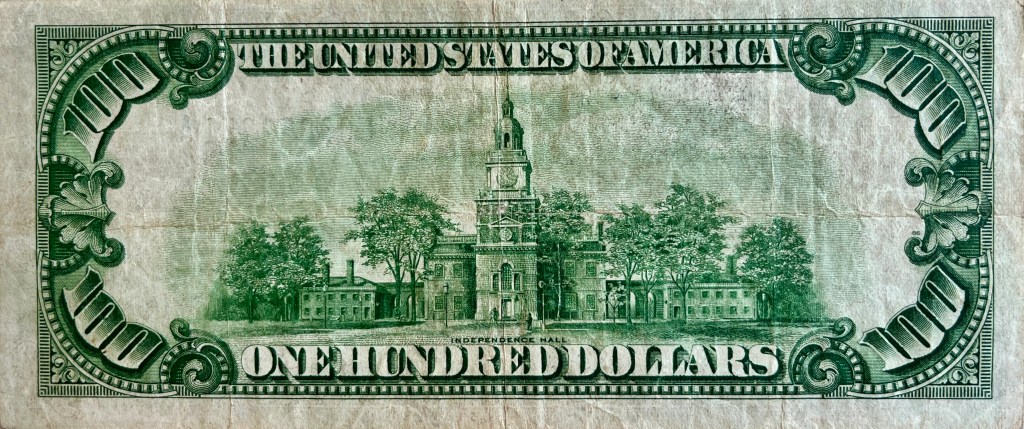
1934 Series Federal Reserve Note
By 1934, it had been 20 years since Benjamin Franklin (1706 – 1790), occupied the $100 note’s obverse. Although not a president, Benjamin Franklin is a principal founding father of the United States of America. He was part of a committee that created the Declaration of Independence. In addition to signing it, he also signed other important treaties that helped establish America’s sovereignty as a nation. Franklin was also an inventor, scientist, and writer. Among some of his inventions are the lightning rod, bifocals, swimming fins, and a flexible catheter. He is the only other non-president on federal reserve notes. The other person is Alexander Hamilton on the $10 bill.

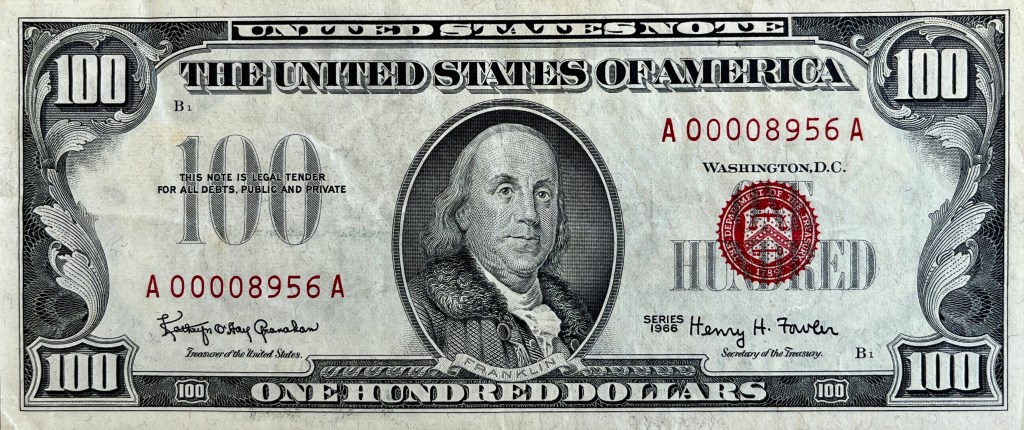
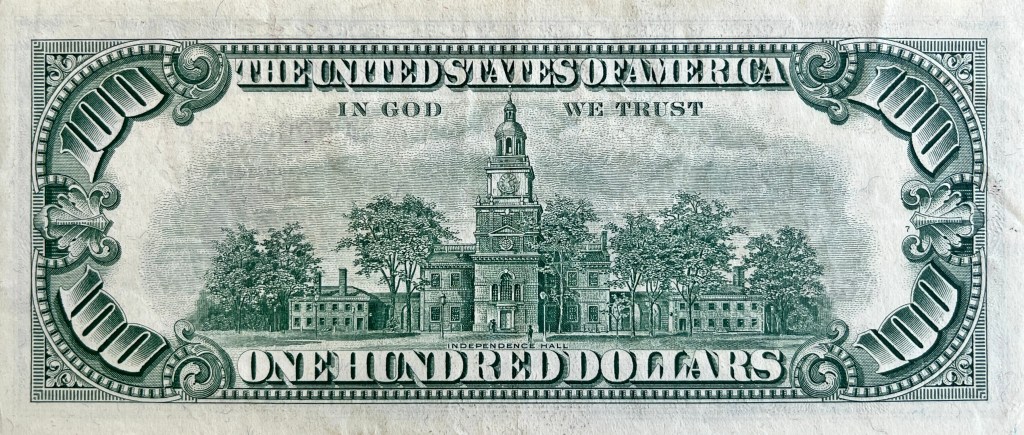
1966 Series United Stated Note
The 1966 Series was introduced to inject $100 notes into the nation’s money supply alongside Federal Reserve Notes. These new $100s were issued by the US Department of the Treasury (just like the 1963 Series $2 and $5 notes), and not the Federal Reserve. The inscription on the Red Seal is featured in English, favored over Latin for the first time. In 1971, United States Notes ceased to be issued however they are still legal tender today.
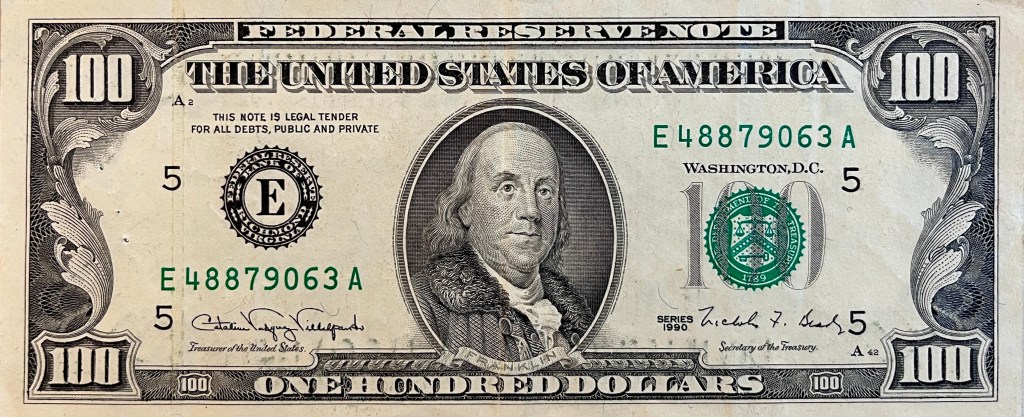
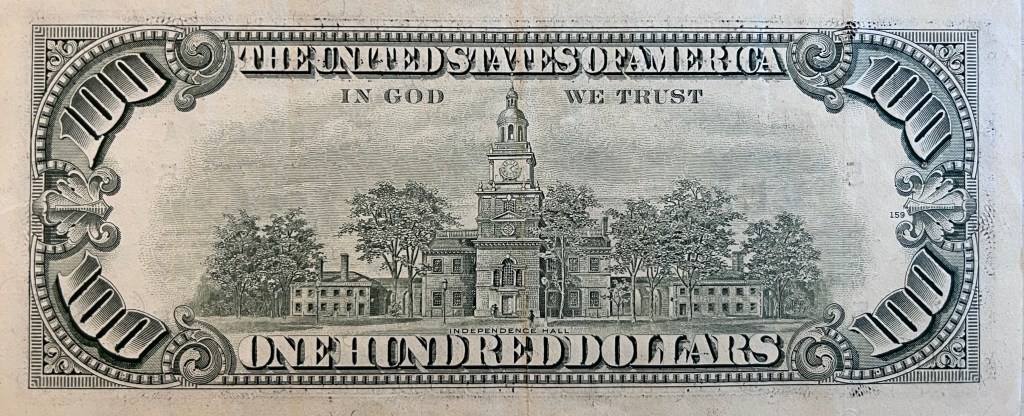
1990 Series Federal Reserve Note
New technological advances allowed for tighter security features to be introduced with the 1990 series as a counterfeiting measure. One such feature is the vertical thread seen next to the “5”s located on the left panel of the note. Another feature is the microprinting around Franklin’s portrait.
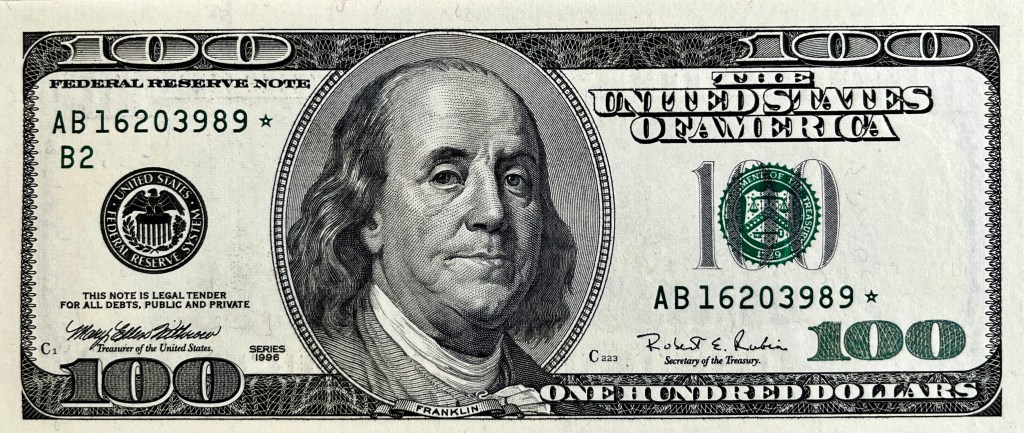
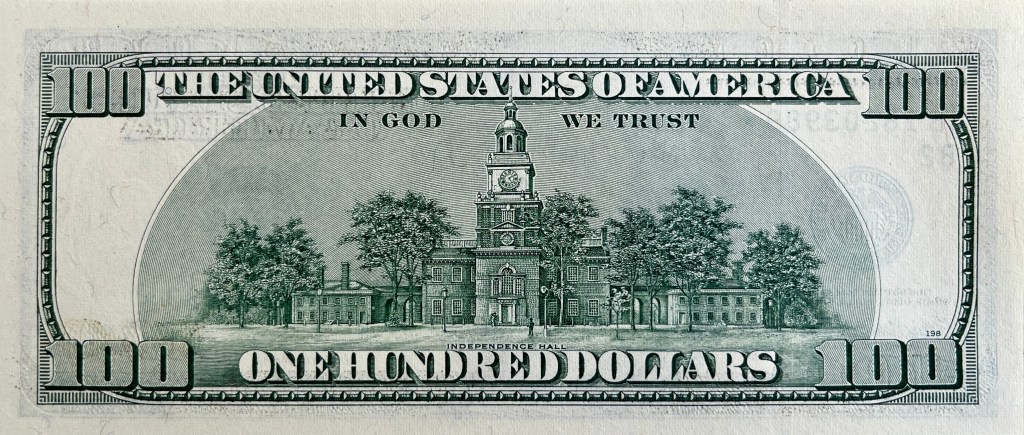
1996 Series Federal Reserve Note
This series marked significant changes in the note’s design, observed mainly in the larger portrait. New security features were also introduced such as a watermark of Franklin to the right of the green Treasury Seal. Color changing ink, also known as optically variable ink, was integrated in this new design. It is triggered when the note is held up to the light. This can be observed in the green 100 on the bottom right corner of the note.
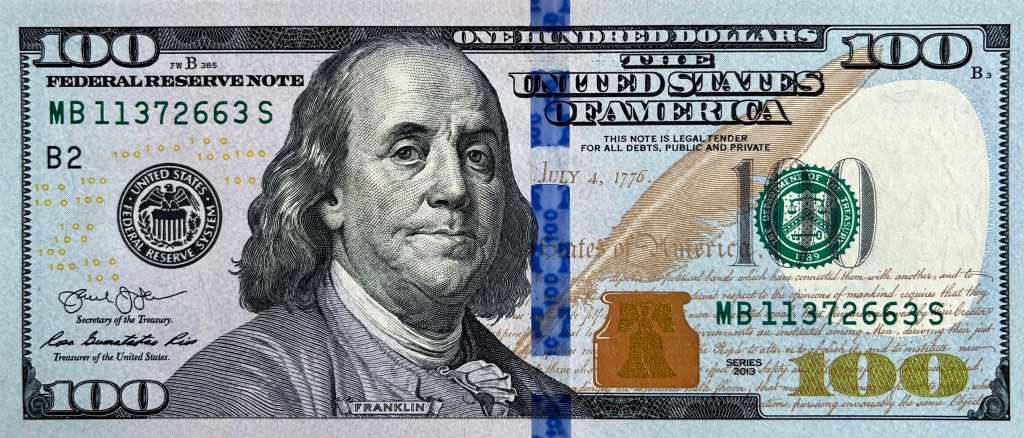
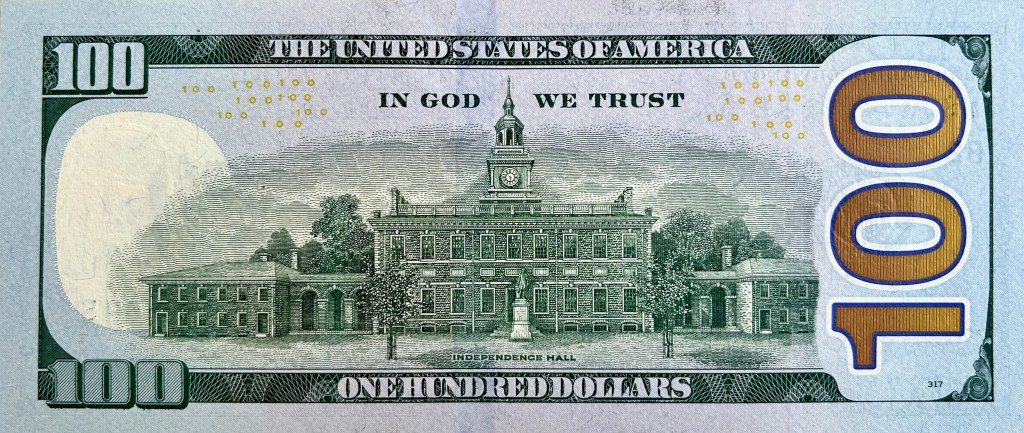
2013 Series Federal Reserve Note
The 2013 series exhibited considerable design changes from the previous series. Its appearance leaped from a monochromatic state to an infusion of color, ushering the C-Note into the 21st century. New depictions include the brown quill and inkwell along with a purplish overlay. Another more modern security feature, the blue 3-D thread, is woven into the note. To its right, a color shifting bell is visible within the inkwell, changing from copper to green.
Looking Ahead
What does the future hold for the $100 note? C-Notes are here to stay as the ubiquitous face of currency worldwide. Franklin’s stoic poker face does not let on as to what may become of the $100 banknote.
Plans to redesign the bill are scheduled for 2034 with integration of ever-evolving protective features. However, with the rise of digital central banking and digital currencies, the threat to banknotes as a whole is real. Arguments from both sides of the coin provide rationale either for or against physical currencies. Due to its global appeal and vast use in legal and illegal transactions, a world in which C-Notes become obsolete is hard to imagine, at least for now.
It remains to be seen whether the 2034 series will be one of many future releases, or perhaps one of the last. Time will look to settle that quandary.

 The Paper Money Guy
One response to “The Most Famous Benjamin of All: The US $100 Note”
Good post Alex. You just get better each time! I’ve seen C Notes around the world. …and many stories about counterfeiting them!
LikeLiked by 1 person