
The Aruba Florin (AWG) was instituted in 1986 when the island became an autonomous nation within the Kingdom of the Netherlands. Historically, Aruba’s status as part of the Netherlands Antilles was that of a colony.
The origins of the term florin may date to gold coins circulating in Florence as of 1252, bearing that name. Over the ensuing centuries other countries utilized the term to describe their currency. They included Austria, England and the Netherlands.
On January 1 1986, the Central Bank of Aruba introduced paper banknotes for the new nation. These banknotes came in the following denominations: 5, 10, 25, 50, and 100. Their dimensions were based on a one size fits all model (147 x 67 mm). The new currency was pegged to the US Dollar from its inception. The rate still stands today at $1 US = 1.79 Afl.
In 1990, a bright new series was launched and was interpreted by artist Evelino Fingal. The series depicted images inspired by Aruba’s wildlife and cultural artifacts (mainly pottery). As Director of the Archaeological Museum of Aruba, Fingal’s exposure to pre-Colombian artifacts inevitably factored into his currency designs. In addition to currency, his designs were also incorporated on Aruba stamps.
Fingal’s Florin series would be expanded to include a 500 note in 1993. However, 1995 saw the 5 Florin note converted to coin format and the banknote was thus discontinued.
In 2003 an updated series of Fingal’s notes were released featuring new security attributes. In 20219 the notes were replaced by a new Aruba Florin series boasting a completely new design. These new notes rendered the Fingal series obsolete, as the predecessors would no longer be accepted as functioning currency. The old notes can still be exchanged at the Central Bank for legal tender notes until August 12, 2049.
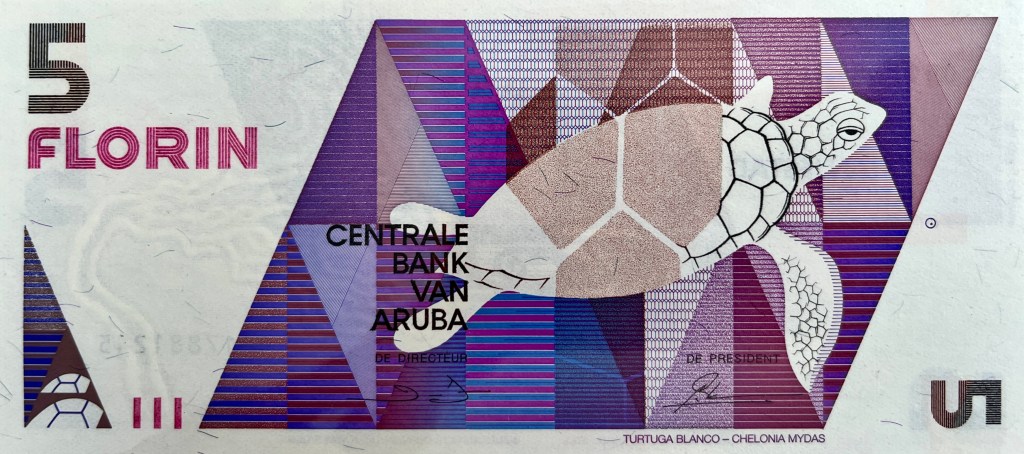
Obverse (1990 Series)
The face of the 5 Florin shows a purple motif on a white backdrop. It features a white turtle (Tortuga Blanco) of the Green Turtle species. A possible explanation for the turtle being white is that it’s an albino. This is a rare but viable condition for the green species.
The note’s “5” denomination is listed on the top left and bottom right corners. Towards the bottom left, three vertical tactile strips intended for the visually impaired help distinguish the note’s value. The prominent inscription “CENTRALE BANK VAN ARUBA” is in Papiamento, Aruba’s dominant official language (composed of a mix of Spanish, Portuguese and Creole). The other official language is Dutch and is mainly used for administrative matters. The signature of the President of the Central Bank can be seen under the turtle’s front right leg.
The note bears minimal security markings in form of the multi color fibers on the white portion of the background. The other less conspicuous feature is a watermark situated right under “FLORIN” within the left upper portion of the note.
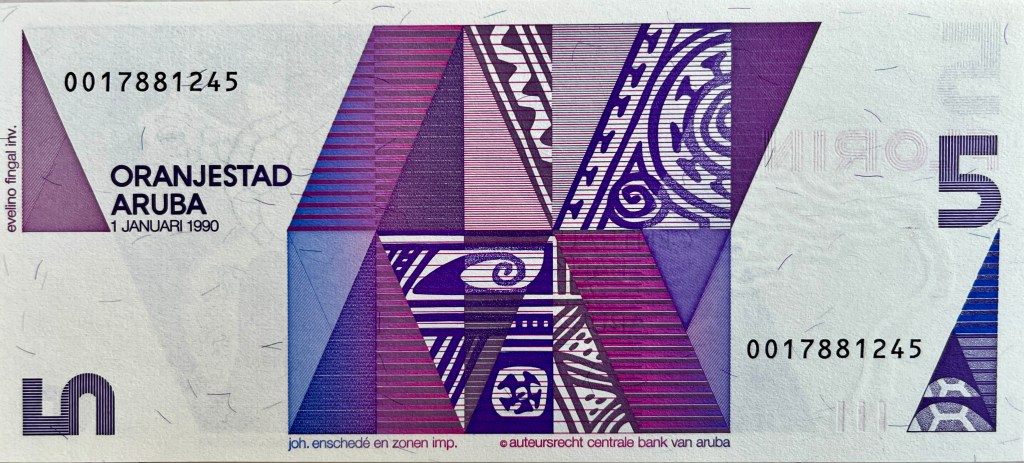
Reverse
The back of the note mimics its face to a degree. The purple motif is present here as well acting as a palette for the pre-Colombian Aruban art. The note’s serial number is visible in two opposing locations. The date of issue is noted alongside Aruba’s capital name, Oranjestad. Similar to the obverse, the denomination is listed twice on this side as well. Evelino Fingal’s name is found in the upper left corner, a nod to the artist behind this unique series.
My Two Cents
The Aruba Florins of the 1990 – 2003 series are quite unique. If there was ever a banknote series that didn’t resemble paper money, it would be the Florin. I’ll never forget the time when I had first encountered them and the reaction I had. This can’t be real, said a voice in my head. A friend had returned from an Aruba vacation and retained a few Florin notes. I don’t remember exactly how the bills surfaced, but when they did, I was taken aback by their non-conformist appearance. They struck me as more as an art series or even funny money. Their design appeared quite minimalist yet highly expressive in the depiction of the local fauna. The subdued pastel colors hinted to subtlety not flashiness, the way other currencies can come across. Subliminally, my collection beckoned for them.
The Aruba Florin made quite an impression on me, needless to say. From that moment, I knew I had to pursue them. A couple of years later, while on a trip to the autonomous island myself, I acquired several notes from the central bank. The bank is accustomed to dealing with collectors which is always a treat.
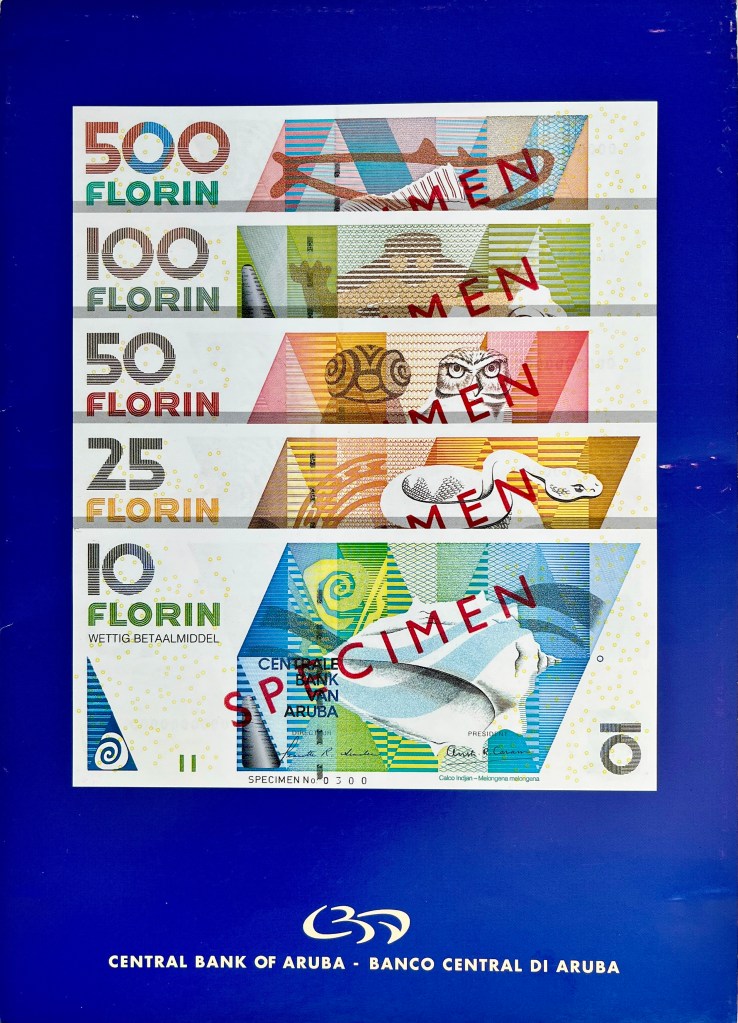
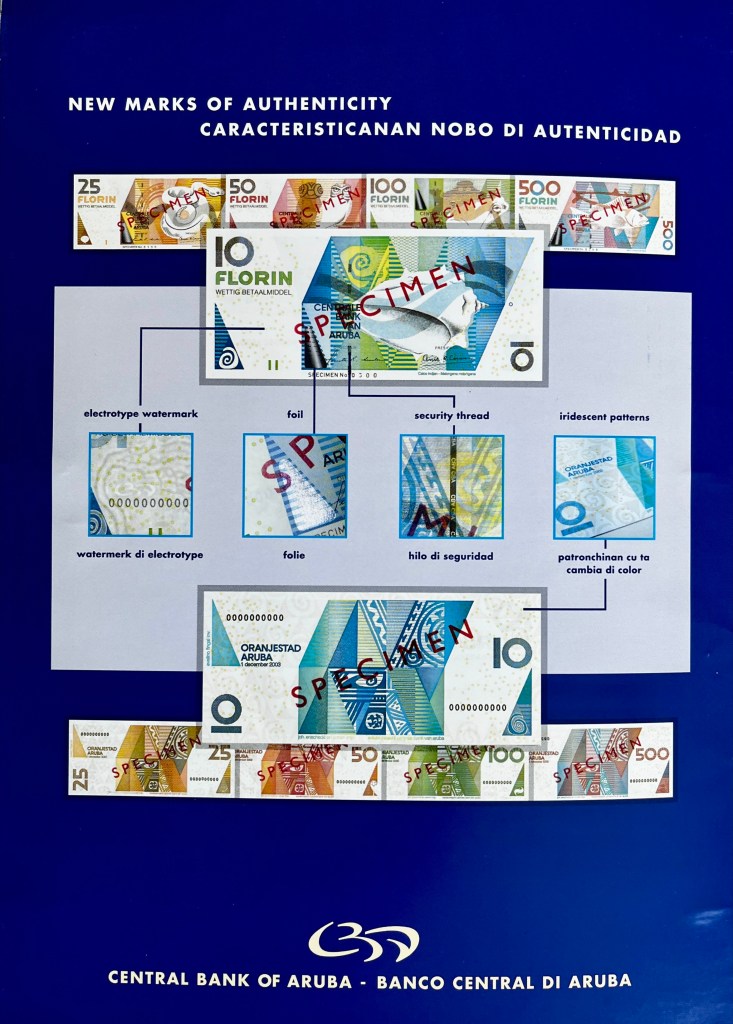
Although the 5 Florin note was sold out, I was able to acquire it from an eBay vendor soon after. The only remaining note from that series still “WANTED” is the 500 Florin. Perhaps the time has come to plan a return visit to the Caribbean nation and complete the series.

 The Paper Money Guy
One response to “Going All In for the Aruba 5 Florin”
Aruba?! Your messages are really targeted. Looks a bit like funny money, indeed!
LikeLiked by 1 person