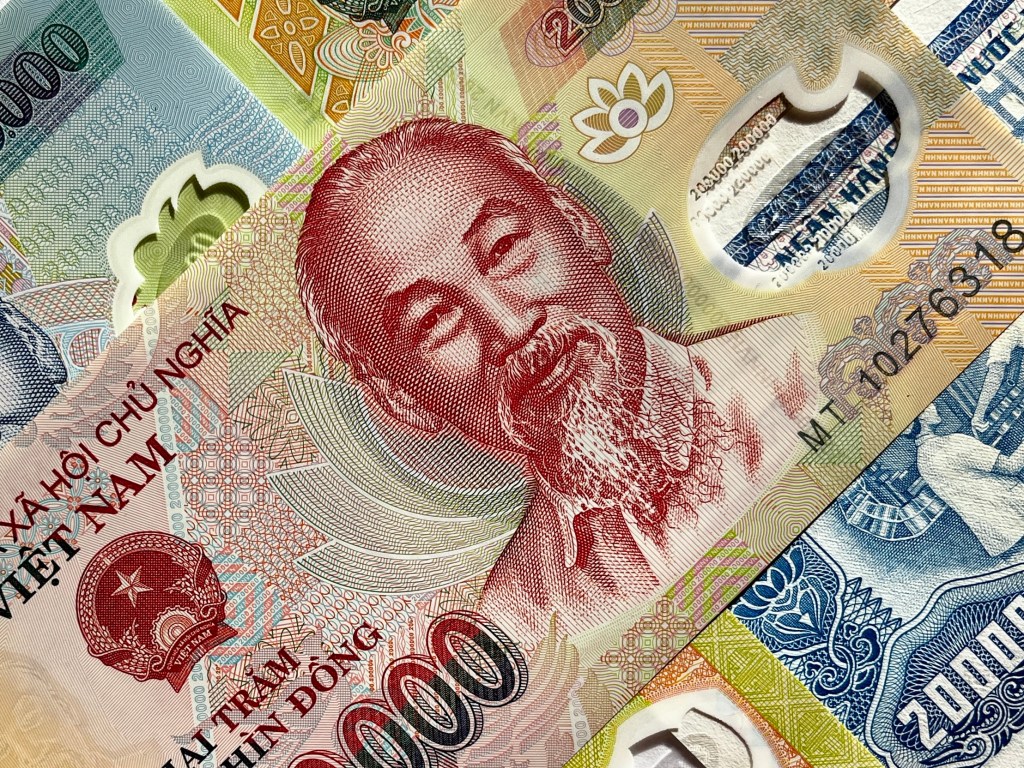
The 200,000 (VND) Dong note was first introduced as part of the 2006 Series as a polymer note (made from plastic film). Polymer notes have become more popular in the past couple of decades due to their durability and propensity to support enhanced security features. Vietnam was one of the first Asian nations to introduce polymer notes in 2003 (Australia led this movement in 1998 as the first country to convert its currency from cotton paper to polymer notes).
Today, the State Bank of Vietnam issues polymer notes in the following denominations: 10,000, 20,000, 50,000, 100,000, 200,000 and 500,000. The notes are not of equal size (the 500,000 is the largest note and each lower denomination decreases in length while the height remains consistent). The different sizes are meant to render them more distinguishable from one another. Similar to many other nations’ currency systems, Vietnam uses a dot in place of a comma as the thousands separator (contrary to the US based number format).
Obverse
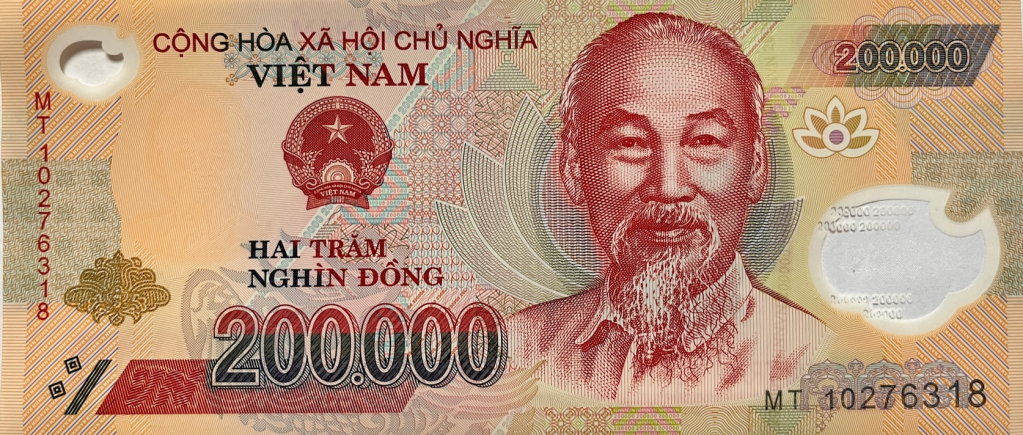
The featured 200,000 Dong note (exact series unknown), showcases former president Hồ Chí Minh born Nguyễn Sinh Cung (1890 – 1969), on the obverse. Hô Chí Minh served as president of Vietnam from 1945 until 1965 (when he stepped down to due health reasons). He is regarded in Vietnam as “Uncle Ho” and Hồ Chí Minh translates to “Bright Spirit”. In 1930 he founded the Communist Party of Vietnam which ultimately influenced the direction the country would end up pursuing politically.
In August 1945, Hồ Chí Minh fought for independence against French and Japanese colonial occupation in what is known as the August Revolution. The uprising marked the beginning of Vietnam’s independence movement and resulted in the formation of the Democratic Republic of Vietnam. Aside his career as a politician, Hồ Chí Minh was also a writer, poet and journalist and spoke (and wrote), several languages, among them French, Russian, Cantonese, and Mandarin (in addition to his native tongue, Vietnamese).
Reverse

The reverse of the note captures Ha Long Bay, a picturesque landscape in the Quang Ninh province characterized by limestone formations rising from the sea. The rock formation pictured on the note is Dinh Huong Islet and it is one of thousands of such islets along with islands that make up the stunning location. Ha Long Bay, a UNESCO World Heritage Site is consistently Vietnam’s most popular tourist destination.
There are several security features on the note including a prominent vertical strip where the words “Viêt Nam” are located. An important tactile feature is the raised printing of the name of the country and the denomination which are felt upon contact with the note.
Other features comprise the water mark of Hô Chí Minh to the left of his portrait and a transparent patch to his right, depicting the 200,000 denomination repeatedly (best viewed when the note is held up to the light). Micro printing of the inscription “NHNNVN” and 200,000 appear in sequence on various parts of the note and are best observed under a magnifying lens.
One key attribute omitted from the note is the date of issue, although I am certain the note was released pre-2012 as I acquired it while in Vietnam in October 2011.
In addition to polymer notes, there are other banknotes in circulation today in Vietnam. These are lower denomination notes such as the 1,000, 2,000 and 5,000 notes which are all made of cotton material. In 2003 The State Bank of Vietnam introduced coins that were meant to replace these notes however their adaption did not gain much popularity.
My Two Cents
Vietnamese Dong notes offer collectors the opportunity to diversify their lots by acquiring both polymer and cotton paper notes that were released over the past few decades. The 200,000 Dong is a beautiful, modern and vibrant note that captures historical and cultural icons, a national hero in Hồ Chí Minh as well as a unique and awe inspiring destination, in Ha Long Bay.

 The Paper Money Guy
2 responses to “200,000 Dong Vietnam: Down by the Bay”
Well written Alex. I never thought I would find banknotes so interesting!
LikeLike
I find them as interesting as the stories they tell (mini history lessons, if anything). Thanks for checking out the post, James!
LikeLike