
The $50 (TTD) note issued by the Central Bank of Trinidad & Tobago first came into existence in 1977 alongside the $100 note. Prior to 1977, the bank’s inaugural dollar series was introduced in 1964 and comprised the following denominations: $1, $5, $10 and $20. This marked the beginning of Trinidad & Tobago’s very own dollar as the national currency as an independent nation. In the centuries leading up to the 20th, Spanish and Mexican dollars as well as English Sterling Pounds served as the currencies of the times circulating throughout the West Indies or the Caribbean which included present day Trinidad & Tobago.
The $50 note has an interesting history as soon after it was introduced into circulation, a shipment of unissued notes was stolen. This caused the government to pull the $50 denomination out of circulation as a security measure. The aftermath resulted in several unforeseen consequences. First, the $20 and $100 notes were issued at larger volumes rendering Trinidad & Tobago to have the highest number of banknotes per capita in the world. Second, the $50 note had virtually disappeared for decades and when it was finally reintroduced in 2012, many people did not receive the note well at all. Some (the most senior constituents of the population), had difficulty discerning it from the $5 and $10 notes due to similarities in appearance.
The 2012 Series $50 note was released (in August 2012), to commemorate 50 years of independence for Trinidad & Tobago, however this led many to believe the note was a collector’s item and in turn saw very little use in commerce. Some experts argue that the lack of consultation on behalf of the central bank with other banks, businesses, and history experts contributed to the low adoption of the note.

Obverse
The 2012 Series note (some notes labeled as “Series 20006”), depicts a Red-Capped Cardinal on the left portion of the obverse, the Coat of Arms of Trinidad & Tobago in the center, and a watermark along with a hologram of the bird on the right panel. The note is made from cotton material and its dimensions are 156 x 66 mm which is consistent with the other denominations in the 2012 series. There are two serial numbers listed, one in black running horizontally and another in blue in vertical orientation. Both ascend in size from their initial position towards the final character. The note also bears tactile bars on its margins catering to the visually impaired.
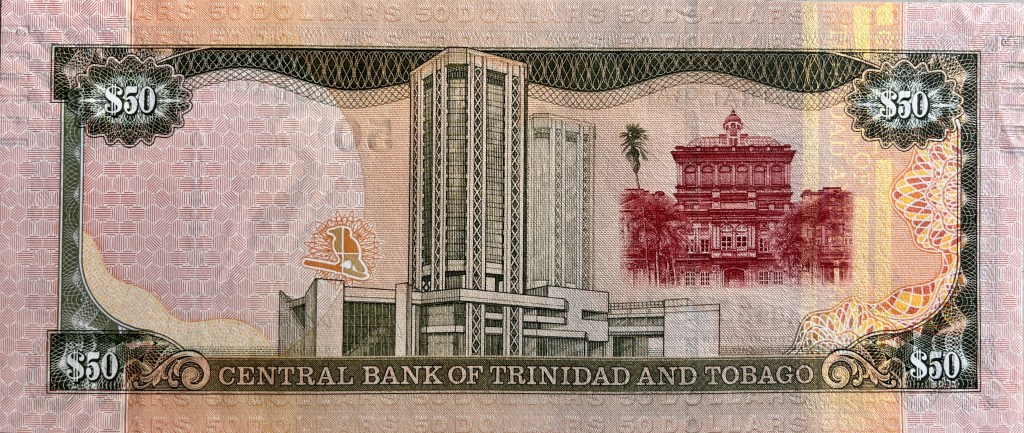
Reverse
On the reverse the nation’s Central Bank building is featured within the Eric Williams Financial Complex along with the Beaux-Arts style Parliament Building (also known as the Red House), in a dark red tone. A 2mm vertical windowed security thread is visible on either side of the note bearing the inscription “CBTT 50”.
2014 Commemorative Golden Jubilee $50 Polymer Note
The 2014 Commemorative Note was released to celebrate a Golden Jubilee on the 50th anniversary of the Central Bank. It would be the bank’s first polymer issue which would be followed by an all-polymer series several years later.

Obverse
On the obverse the national Coat of Arms is featured more prominently than in the previous series, a Hibiscus Flower and the Red-Capped Cardinal. A smaller version of the hibiscus flower possessing iridescent qualities is also observed. The serial number appears twice, once in blue running vertically and again, this time in black running horizontally. Similar to the 2012 series note, the serial number ascends with each ensuing character. Tactile bars can be felt on the upper vertical margins of this note as well.

Reverse
Similar to the 2012 Series, the reverse portrays the Central Bank building at the Eric Williams Financial Complex, the Red-Capped Cardinal and a Children’s Carnival Masquerader. The rich orange, gold, and red tones combine for a vibrant contrast with the green blue iridescent wings of the cardinal. It’s not difficult to see why this note won the International Banknote Society’s “Banknote of the Year Award” in 2014.
Recent Developments
In late 2019 through the beginning of 2021, the Central Bank of Trinidad & Tobago introduced a new polymer series in $1, $5, $10, $20, $50 and $100 denominations which would eventually replace all previously issued notes. As such, the following announcement is currently posted on the bank’s website: “All banknotes bearing series dates prior to 2020 are now no longer legal tender. The redemption of the $1, $5, $10, $20 and $50 notes bearing series dates prior to 2020 will be facilitated indefinitely at the Central Bank.”
My Two Cents
Not sure where to start exactly.. the $50 Trinidad & Tobago note has caused quite a stir over the past few decades! From a mysterious stolen shipment of the original notes in the 1970s (would love to know what ever happened to those notes and how to acquire one), to the suspension of the 50 denomination, to the confusion inducing 2012 50-years of independence issue, and the 2014 Banknote of the Year acclaim, this note bears all the markings of an intriguing investigative documentary, Netflix anyone? All in, the $50 Trinidad & Tobago note continued to evolve, now as a polymer, it reminds us that a bill’s tale stretches far beyond its face value and the subjects depicted on its sides.

 The Paper Money Guy
6 responses to “50 Dollar Note Trinidad & Tobago: Missing in Action for Over 30 Years!”
Such colorful banknotes! The adventures of the missing shipment… perfect stuff for an exciting BD. It seems that smaller and tropical countries have more interesting banknotes and stamps. I find the bills in the US, all of the same size and color with only presidents on them to be pretty dull.
LikeLiked by 1 person
Couldn’t agree more, beautiful notes are representative of many countries in the Caribbean. And a great plot for a fun BD indeed. US notes are not out of the box pushers, they’re more about consistency and legacy. As the principal global currency, it would be drastic to change too much as the impact would be global (and that could have some negative consequences, similar to Trinidad & Tobago’s 2012 series $50).
LikeLike
Absolutely fascinating! So much mystery and history behind a litt
LikeLiked by 1 person
Hopefully one day the mystery is unraveled.
LikeLike
Have you looked online for any $50 notes? I love how they incorporated hibiscus…seemingly random but I get it.
LikeLiked by 1 person
It would be too easy to find them online. Someone somewhere must know something. The hibiscus adds a nice pop of color. Banknote of the Year!
LikeLike