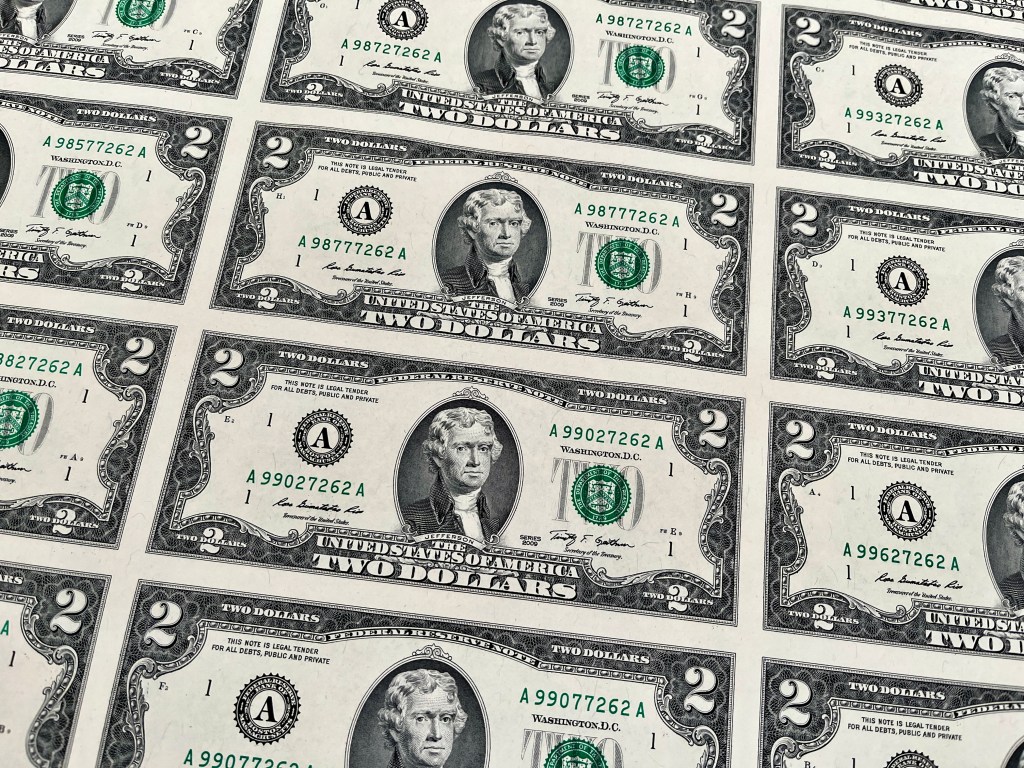
There has been a bunch of noise recently about $2 US notes and their value, that emanated from numerous media outlets like USA Today, Yahoo Finance, CBS among others. The fascination with America’s elusive $2 bill (aka the “Tom”), seems to have gripped the public’s attention once again.
In the spirit of playing along, I decided to do my part as a collector and reignite the curiosity behind the value of my $2 bills. So, I took stock of my collection however only to relearn what I already knew. No wild outliers here, no crazy high value ringers among my modest stash. Oh well.. That said, curiosity can sometimes lead to action and in doing so I phoned the local bank and asked to pull some $2s out of their vault. Perhaps playing detective might lead to something new, something mysterious or even something grand (in value that is). After sifting through a couple of $200 bundles (newly printed notes come in sets of 100 when distributed to commercial banks by the Federal Reserve), the result remained consistent, nothing to see or boast about here. All was in order, nice and neat in perfectly ascending serial numbers, not even a small blemish to draw further scrutiny. Blemishes aka errors on notes are huge factors that impact the value but more on this in a future post. Oh well.. at least the chase was fun and in the end, I added a few new $2 notes from the 2013 series to my collection. Note: a bill’s condition is the primary factor contributing to its value above and beyond the denomination it bears. Notes in Uncirculated condition (the highest grade), will warrant the highest values.
A Bit of History About the $2
The United States $2 note has been around since the mid-1800s and along the way has changed appearances, subjects featured, sizes, and the promises it claimed to its possessor. The first $2 note was issued in 1862 and featured Alexander Hamilton, founding father and the nation’s first Secretary of the Treasury. It bore a red Treasury Seal and it was quite larger (7.421 x 3.125 inches), than modern day dollars (the size of today’s notes are 6.14 x 2.61 inches, about 30% smaller than their predecessors).
The size change came in 1928 as part of a redesign of all denominations as a way to more efficiently print bank notes.


In the early days of the $2 note first being issued, the Federal Reserve or a centralized bank designed to control the nation’s money supply was still many years away from being established. Over the ensuing decades several iterations of the $2 were issued as United States Notes, Silver Certificates, National Bank Notes, Treasury Coin Notes, Federal Reserve Bank Notes and finally Federal Reserve Notes. Different iterations brought on new features in design, seal colors and motifs, serving as a reminder that not all $2 bills were created equal.
The note type was mainly established by the issuing authority and their statutes (this primarily included the US Treasury and The Federal Reserve). Notably, Silver Certificates were in a class of their own. The promise of such a note was that the bill was redeemable in an equal amount of silver coins (or silver bullion). This phenomenon was linked to the Silver Standard which backed US dollars with precious metal. A Gold Standard also existed prior to (and alongside) the Silver Standard, although during the 1960s and early 1970s, both were completely abandoned by the US government.
Today, our money is known as fiat currency and is no longer backed by anything tangible (such as physical assets). One can infer that it’s simply based on faith in the nation’s credit and state of economic stability. Perhaps comforting to some degree is the fact that 60% of all US dollars actually exist outside of the United States, as the dollar reigns as the preferred global currency.
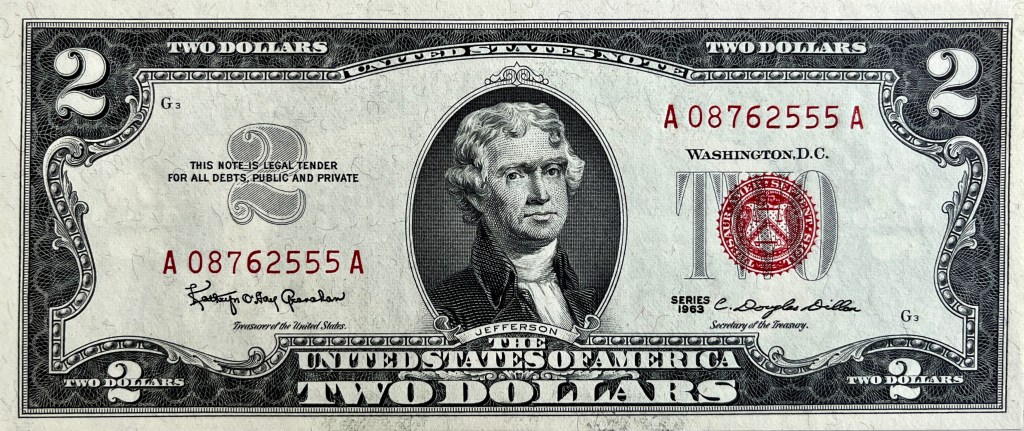

With the inception of The Federal Reserve in 1913 which works in tandem with the US Treasury’s Bureau of Engraving and Printing, the process of creating money and distributing it to commercial banks across the country falls under their purview. As such the nation’s currency system has been standardized under one central bank, The Fed (as it’s often referred to). Our money today is labeled as Federal Reserve Notes and the $2 is one of seven denominations issued. The other denominations are: $1, $5, $10, $20, $50 and $100.
$2 bills are the rarest among US notes as they are printed far less frequently than their sister denominations, not to mention in smaller quantities. As a result, their lasting power, which stretches far longer than the other denominations, can be attributed to their infrequent use.
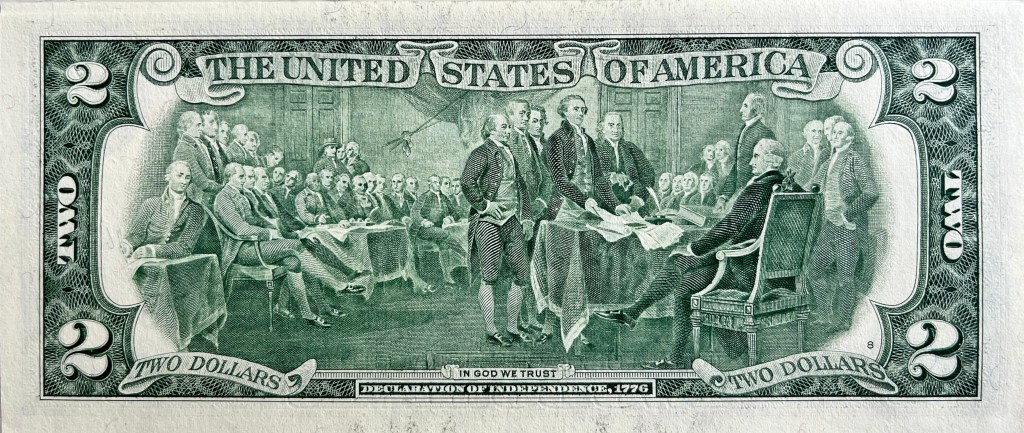
Turning back time, historically the $2 bill was seemingly unpopular from its inception. Many people believed the $2 was bad luck and a result started tearing off the bill’s corners as a way to ward off misfortune. This inevitably rendered the bills unusable. Fast forward several decades and the $2 continued getting a bad rap as in the early 1900s it was associated with gambling, prostitution and corrupt politicians, therefore further distancing its adoption by the public. In 1966, the government ceased producing the notes altogether. However that didn’t last too long, as the nation’s bicentennial in 1976, brought on the advent of a newly designed $2 note, featuring the signing of the Declaration of Independence on the reverse.

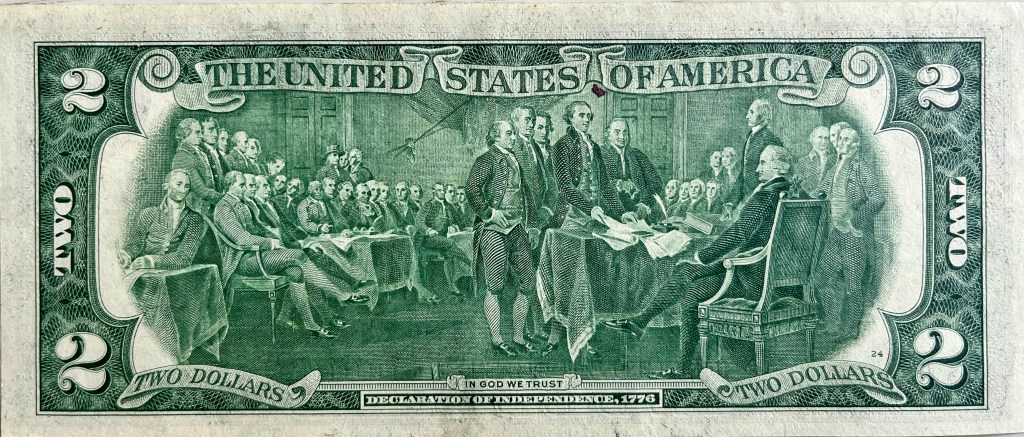
The relaunch was meant to infuse the newly designed notes into circulation, promote their return, and also relieve some of the costs of producing the $1 note. This didn’t go according to plan as many folks took the new series for commemorative notes and began collecting them, thus abetting their proliferation. In fairness, it was not hard to blame them. One reason, on the first day of issue to celebrate the nation’s bicentennial, one could bring a $2 note to a post office and get it stamped with the date of April 13, 1976 (Thomas Jefferson’s birthday). This phenomenon rendered those notes as mementos more so than cash, and they managed to remain popular with collectors to this day.

Obverse
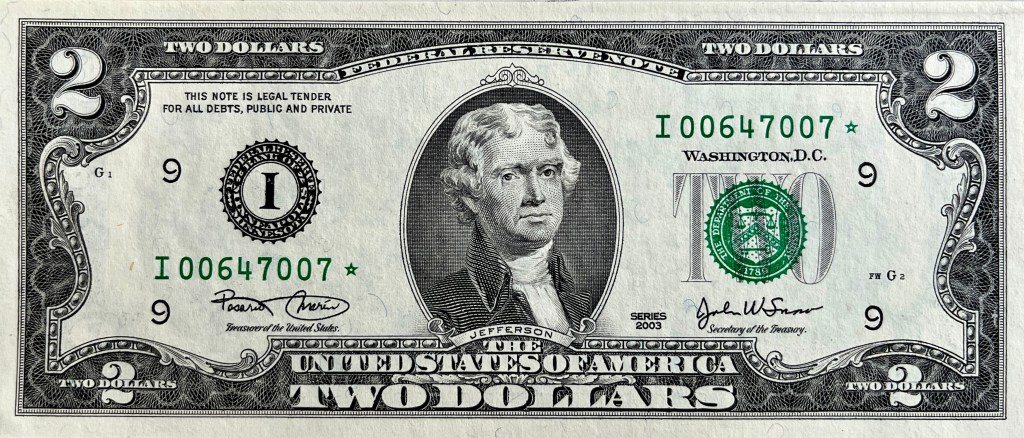
The $2 note features Thomas Jefferson (1743 – 1826), founding father and 3rd president of the United States of America. Jefferson’s portrait first appeared on the $2 note in 1869. The note’s general design remains virtually unchanged as only subtle tweaks were made since the 1928 version to the most current issue (2017). On the left panel, the Federal Reserve Bank seal can be seen surrounding the letter “I” which indicates the Fed’s Minneapolis banking branch (one of twelve such banks). on the right panel the seal of the US Treasury is featured in green over imposed on the large “TWO” print.
The security features are modest and include raised printing across some of the note’s characters and red and blue color fibers. The note is made from a combination of cotton (75%) and linen (25%).
At this time, there are no plans to redesign the $2 note. So far all other denominations except the $1, have been redesigned since the mid 1990s.
Reverse
The reverse captures John Trumbull’s depiction of the signing of the Declaration of Independence. This motif was first introduced with the 1976 Series notes. Of the 47 persons who appear in Trumbull’s original painting, only 42 are captured on the banknote (all of whom were signers).
My Two Cents (or should it be two dollars in this case..?)
To say that America’s $2 note has an enigmatic history is a quite the understatement. Despite its checkered past and lack of winning popularity contests with the public, the note is perhaps the most resilient of any among US banknotes. $2 bills represent about 1% of all US dollars produced, most people never have them on hand and businesses most often do not furnish them as change. It’s no surprise then there is something novel about encountering a $2 bill, which helps understand why many preserve them as a currency icons or perhaps lucky notes, thus amplifying the passion for them.
So what are $2 bills worth and why all the recent buzz about their value? There’s no quick answer really as so many factors come into play like series of issue, condition, type of note, etc. Some notes can in fact fetch values into the several thousands, however unless you’re in possession of some really, really old notes (like over 100-years old), or the note has a super low serial number (with like 5, 6 or 7 sequential zeros in the beginning), or perhaps a star after its serial, or a cancelled postage stamp on it, or maybe they have printing errors (all this while maintaining that uncirculated or close to condition), then you can rest assured that they are probably worth.. you guessed it, $2! There are some exceptions of course as someone may be willing to offer more than face value but generally speaking, the note has to be pretty rare and also possess some uncommon qualities.

 The Paper Money Guy
3 responses to “$2 Dreams: How much are your “Toms” worth?”
I just read it
LikeLiked by 1 person
Hey Alex. Where do you find the time to do these articles?! They are consistently interesting and my knowledge of paper money has gone up more than 500%! Maybe you can eventually figure out this passion of yours into an income stream…
Best to you over the holidays. We look forward to seeing you all very soon.
James
>
LikeLiked by 1 person
[…] However, in most cases, it is only worth its face value. I jumped on this $2 joyride and wrote up a post as […]
LikeLike