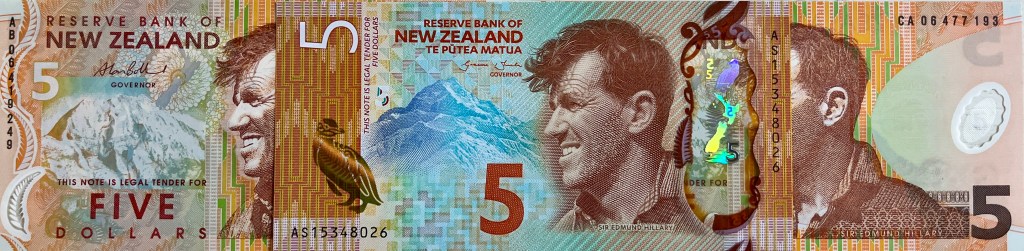
The New Zealand Dollar (NZD), was introduced by the Reserve Bank of New Zealand in 1967 as the nation’s new currency taking over for the Pound. The $5 is one of five current denominations (the others are: 10, 20, 50 and 100), and since 1999 all of have been issued as polymer notes. The sizes vary among the denominations and the $5 is 135 x 66 mm with horizontal orientation. Five series of New Zealand dollars have been introduced since 1967. The fifth series in the 1990s saw the $1 and $2 notes converted to coins rendering the $5 as the smallest banknote denomination in circulation.
Informally, the New Zealand Dollar is known as the “Kiwi” or “Kiwi Dollar”, its name being derived from New Zealand’s flightless endemic bird. The New Zealand dollar is among the top 10 traded currencies around the world and serves as official legal tender not only in New Zealand but several other territories as well. They include the self governing Pacific Islands (Cook Islands and Niue), a New Zealand dependent territory (Tokelau Islands), a territory in Antarctica known as the Ross Dependency (that’s claimed by New Zealand), and the British territory of Pitcairn Islands.
Queen Elizabeth II of England was featured on all New Zealand dollar denominations between 1967 – 1992, due to New Zealand’s membership in the Commonwealth, an international association of states of former British territories, whose head of state is the English monarch.
In 1992 the design of the notes changed to integrate key New Zealand national figures. The Queen however, remained on the $20 note which will eventually be replaced by a newer version featuring King Charles III (as the Queen passed in 2022). Among the other national figures portrayed on the notes, Sir Edmund Hillary has been the subject of the $5 note for over 30 years.
Obverse
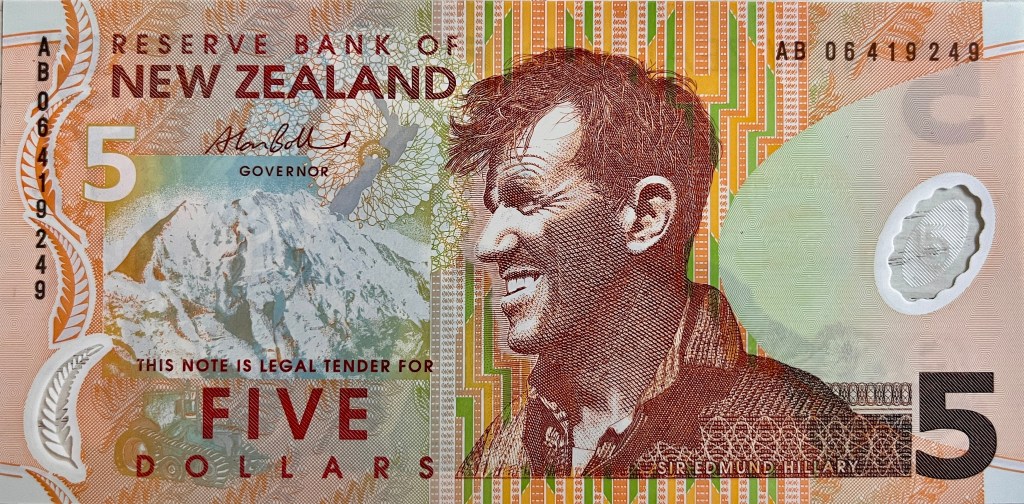
Sir Edmund Hillary’s portrait is the prominent subject on the note’s face along with Mt. Cook (New Zealand’s tallest mountain seen to his left). Hillary (1919 – 2008), was the nation’s most famous mountaineer who gained world fame for being one of the first two persons to summit Mt. Everest, the world’s tallest Mountain at over 28,000 feet. Hillary achieved this feat in 1953 in tandem with Tenzing Norgay, a highly experienced Nepalese Sherpa whose famous image atop Mt. Everest has been abundantly immortalized by history. Ironically, no photos of Edmund Hillary were taken on Everest’s summit. Hillary’s adventures stretched to other world first records such as reaching the South Pole via motorized vehicles. Although he was mainly known as a mountaineer and an adventurer, Hillary also served as a New Zealand diplomat and pursued a life of philanthropy. In 1953, shortly after the Mt. Everest expedition concluded, he was knighted by Queen Elizabeth II.
In the background of Hillary’s portrait is a Māori kaokao pattern symbolizing strength and shelter and reflects a Māori meeting house at the University of Auckland. The note’s serial numbers appears twice, first on the left panel vertically and again in the top right corner horizontally.
Reverse
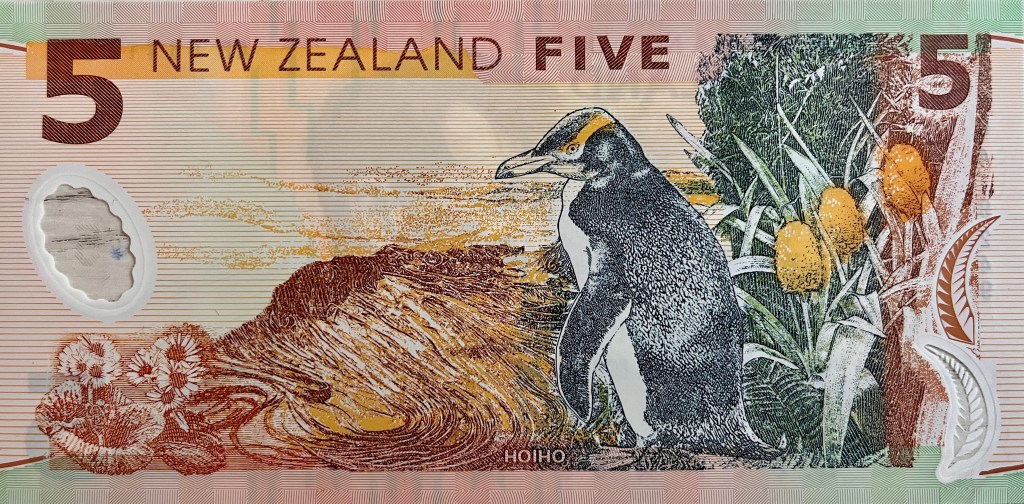
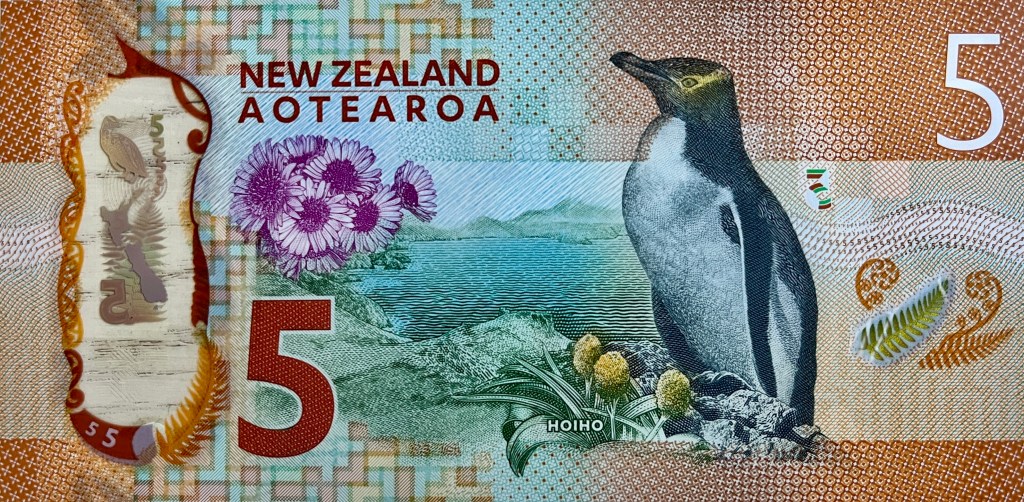
The reverse of the note brings New Zealand’s rich flora and fauna to life led by the rare yellow-eyed penguin (hoiho), that is endemic to the country. The landscape scene the penguin appears to be observing is of subantarctic Campbell Island that is home to a hoiho population. In the lower left hand corner, Campbell Island’s daisies are featured. The other flower observed to the right of the hoiho (also from the island), is the yellow Ross lily.
The security features skew modest and contain a Queen Elizabeth II watermark to the right of Sir Edmund Hillary. To the watermark’s right is a transparent window containing the note’s “5” denomination. Finally, to the bottom left, lies another transparent window in shape of New Zealand’s endemic silver fern. Raised ink can also be detected to the touch on both faces of the note.
The Banknote of the Year 2015 (International Banknote Society)
Obverse
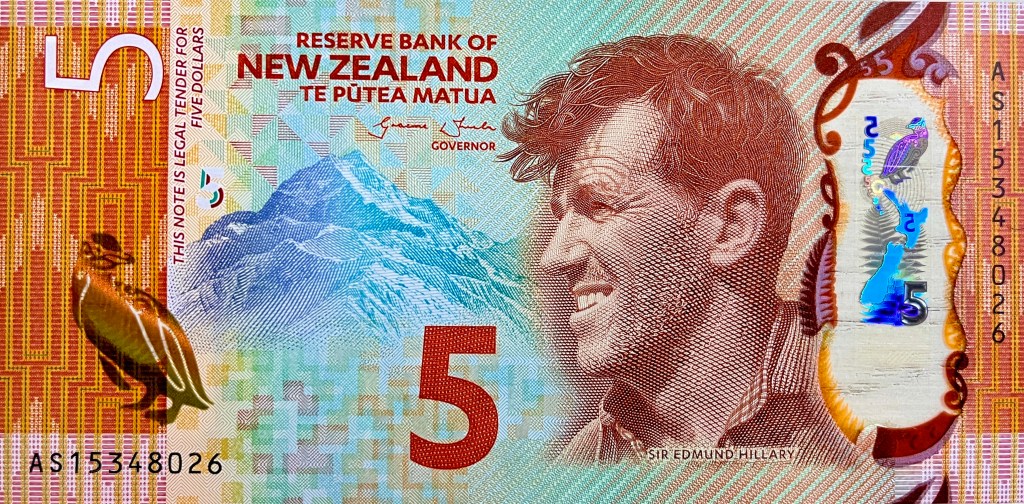
The Series 7 $5 note bears the same size as its predecessor, is also a polymer, and is quite similar in the depictions of the same subjects both on the front and back. Beyond the similarities, there are some new features on this series which include a larger transparent window (containing a hoiho, New Zealand’s North and South islands, and the silver fern), and the duality of English and Māori languages on both faces of the note. Under Ultraviolet Light, a “5” appears just off the center to the left, as an added security feature.

Reverse
On the reverse, the daisies and lilies add a pop of color that further surface the note’s aesthetic vibrancy. Perhaps, it’s not a surprise this note was the International Banknote Society’s Banknote of the Year in 2015.
My Two Cents
The $5 note (and its sister denominations), are a good example of New Zealand’s currency evolution and openness to trying new things. In May 1999, the country became the second to start introducing polymer notes (after Australia), while in 1992 they began integrating national figures to paint a more comprehensive picture of New Zealand’s historical and culturally diverse identity. This is also evident in the inclusion of Māori motifs and eventually the Māori language on the notes, balancing out the once heavily British Commonwealth driven appearance. New Zealand’s $5 note tells a tale of a particular human achievement in pushing the limits with Sir Edmund Hillary’s Mt. Everest feat, and of unique biodiversity found in a remote island location in the Pacific Ocean. All this as a way to introduce anyone in possession of the note to the nation’s rich and wondrous heritage.

 The Paper Money Guy
6 responses to “$5 New Zealand: This Kiwi Doesn’t Fly Either But It’s Got Much Swagger”
Nice article Alex. It’s interesting to me that New Zealand waited until the 1990s to portray their own culture and still use the British monarch who has no real authority over the country! James
LikeLiked by 1 person
I am glad they eventually did, their latest notes are captivating and offer a broader view of their diverse culture, history and natural beauty.
LikeLike
Hey there! We absolutely love reading people’s blogs and the thoughtful content that creators like you produce . Your authentic voice contributes to the diverse online community that we all value . Keep creating and connecting your audience, because your words can make a positive impact on the world. We can’t wait to see what you’ll create next!
Thanks- Jason http://www.pomeranianpuppies.uk
LikeLiked by 1 person
Hey there! We really enjoy reading people’s blogs and the thoughtful content that creators like you share . Your unique perspective enriches the diverse online community that we all value . Keep writing and empowering your audience, because your ideas can make a lasting impact on the world. We can’t wait to see what you’ll share next!
Thanks- Jason
LikeLiked by 1 person
I love your blog. I also collect foreign banknotes. My favorite so far is the Cook Islands $3 note I picked up in Rarotonga last year.
LikeLiked by 1 person
Thanks so much for the feedback, so glad to hear you’re enjoying the blog and that you are a collector as well! The $3 Cook Islands note is a beauty. I picked up many of my notes from travels as well. The notes make for great souvenirs.
LikeLike