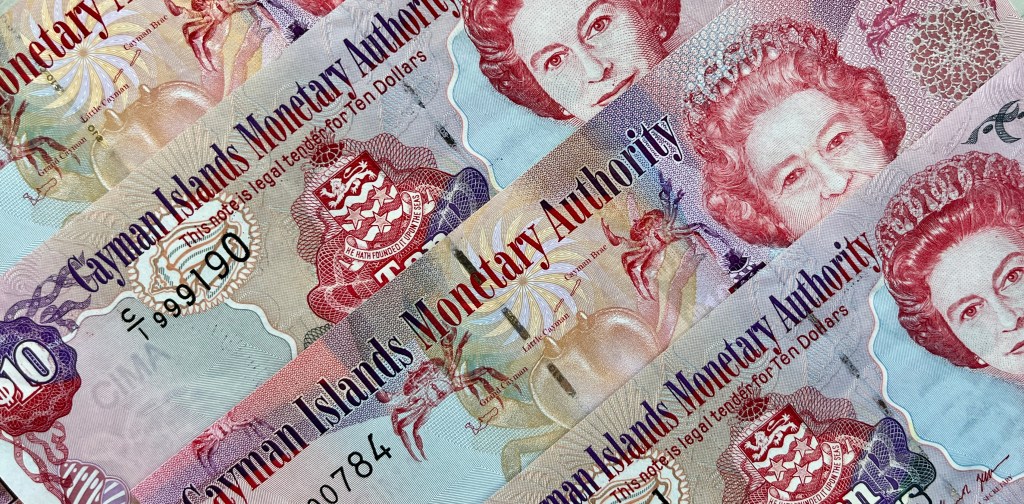
The Cayman Islands Dollar (KYD) was introduced in 1972 as the new currency for the self governing British Overseas territory, that previously shared the Jamaican Dollar as the Caymans’ legal tender. Four denominations were introduced that year starting with $1 followed by $5, $10 and $25. In 1981 the Cayman Islands Currency Board introduced $40 and $100 notes. The $40 was short-lived as it was removed from circulation only a few years later due to its unpopularity. Side note, 40 is quite a rare banknote denomination seen in only a handful of instances over centuries of paper money issuance. Solomon Islands’ 40 Dollar Commemorative Issue note is the most recent example. In 1985 the Cayman Island Currency Board introduced the $50 note which became the 7th denomination issued.
Today, the Cayman Islands Monetary Authority oversees the issuance of currency for the islands and produces banknotes in the following denominations: $1, $5, $10, $25, $50 and $100. All notes are uniform in size with the dimensions of 156 x 66 mm. The Cayman Islands dollar is pegged to the US Dollar at a rate of $1 KYD = $1.20 US, making it among the top 10 strongest currencies in the world (tied with the British and Gibraltar Pound).
Obverse
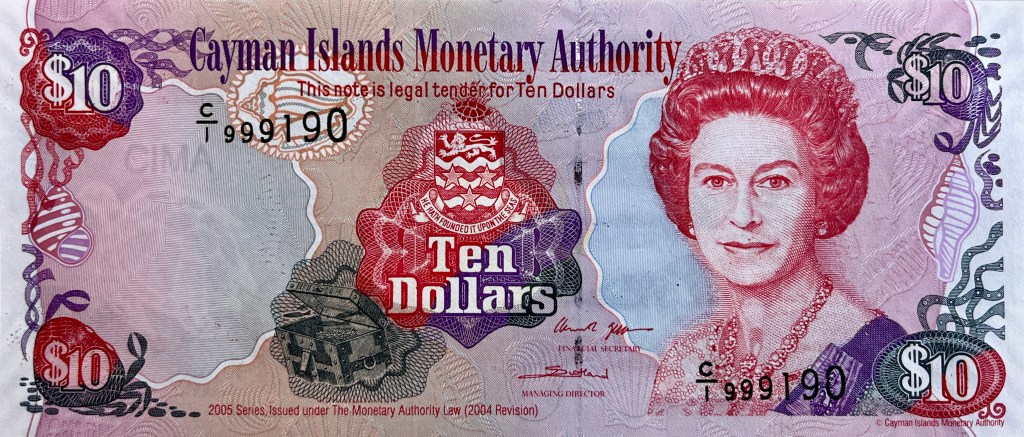
This C Series $10 note was introduced in 1998 along with the $5 and $1 and reflects the updated issuing authority (the Cayman Islands Monetary Authority or CIMA). The note portrays Queen Elizabeth II of the United Kingdom on its face (as do all other denominations), who has been the only person featured on all Cayman Island dollars since their introduction. Fun Fact: Queen Elizabeth II is on the face of 33 different nations’ (and territories) currencies around the world, serving as the most widely featured person and monarch on paper money. Alongside her Majesty, the Cayman Islands Coat of Arms is located at center and a watermark of a turtle appears on the left panel with the inscription “CIMA”. A window security thread runs vertically just to the left of the Queen. Two shells are visible on the vertical margins of the note and a third is located behind the serial number within the upper left portion. Two crabs appear to be hiding behind the $10 in the upper right and lower left corners. The note’s horizontal serial number occupies two spot and exhibits increasing characters.
Reverse
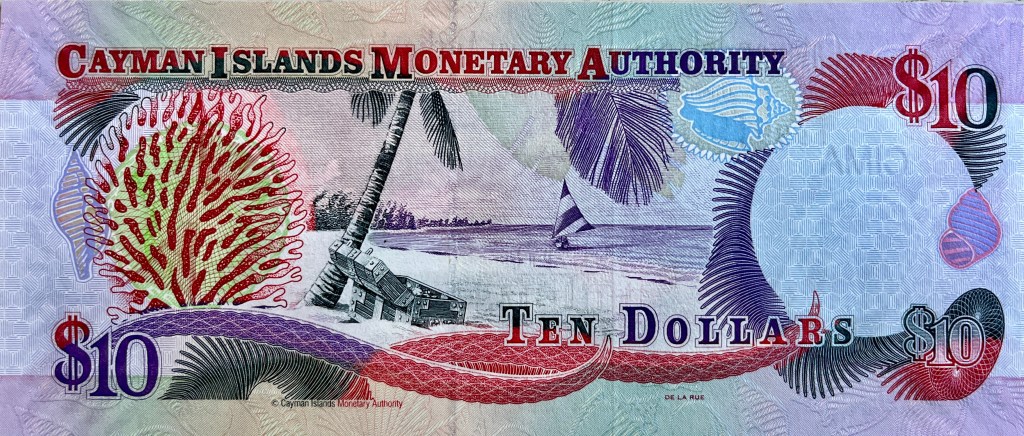
The reverse depicts a serene beach scene with an inviting “treasure” chest under a palm tree. The shells from the obverse along with the watermark turtle are seen on this face as well, and a bright coral reef rounds out the motif on the left panel.

Obverse
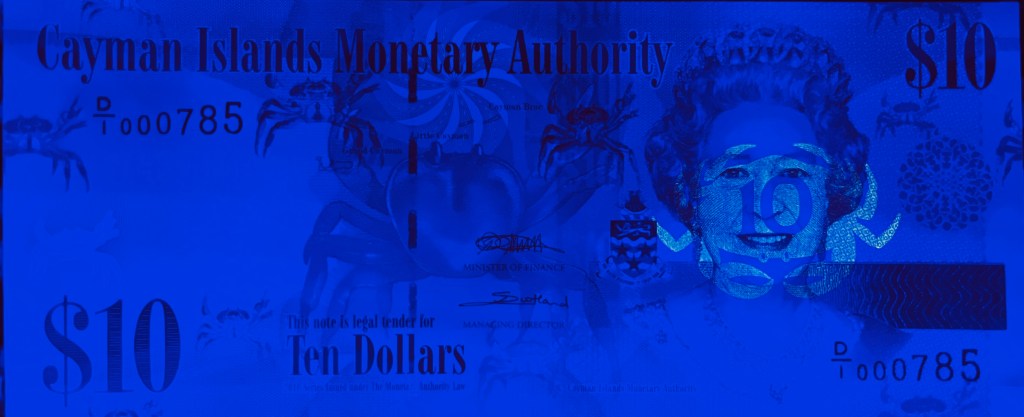
The D Series $10 note’s face is replete with icons and most noticeably portrays Queen Elizabeth II (1926 – 2022), at a more advanced age than in the C series. At dead center is a massive land crab and just above it (and to its left), the Cayman Islands are depicted in their geographical position on the Caribbean Sea. Several other land crabs appear strewn about the note. The half white half pink crab on the left panel has a see-through quality allowing the crustacean to emerge in full view when the note is help up to the light. The Cayman Islands Coat of Arms is visible between the large crab at center and the portrait of Queen Elizabeth II. Similar to the C Series, a watermark of a turtle and the inscription “CIMA” is visible on the left panel. The serial number is shown twice with ascending characters horizontally, just like in the earlier series.
In addition to the watermark, several other security features are imbedded in the note including a 1.4 mm wide window security strip bearing the text “CIMA”. A much wider iridescent band (revealing the “$10” denomination), can be observed just to the left of Coat of Arms, when the note is held up to the light. Within the horizontal dark gray band above the Queen’s left shoulder, a latent image of the note’s denomination appears when the note is held almost flat.

Reverse
The reverse of this D Series note appears simpler than that of its predecessor. It depicts a Wild Banana Orchid at center and the see-through crab from the obverse now appears on the right panel. There is also a “GEMINI” (a printing feature responsive to Ultraviolet Light (developed by banknote producer Thomas De La Rue), on the upper left corner. This is intended as another security feature. Lastly, another conspicuous detail is the significantly larger font (vs. the previous series), in the banking authority inscription and denomination information.
Under Ultraviolet Light

My Two Cents
Caribbean currency, similar to the Caribbean itself, has always had a special effect on me, a way of pulling me in. Rich bright colors, beautiful scenery, lively flora and fauna, all combine for a unique look and vibe of the myriad cultures that converge upon the 700 islands that define the region. Take all of this and accentuate it with the local flare and you have something really special. This phenomenon is aptly reflected in various Caribbean banknotes, telling their stories of the places, people, and the diverse cultures they formed over time.
The Cayman Islands $10 note is a perfect example of this and offers an intimate connection to the islands via its transportative effect. Whether it’s the beach scene or the vibrant colors, these notes allow us to dream of waves crashing onshore, the sweet smell of tropical flowers, or perhaps a gentle sea breeze blowing by. They are among some of my favorite notes to collect and learn more about. Last year, a commemorative $70 Platinum Jubilee Banknote was released one year post the passing of Queen Elizabeth II, celebrating her 70 year reign as monarch. This note would make for a dreamy addition to anyone’s collection.

 The Paper Money Guy
One response to “$10 Cayman Islands: The Perpetual Reign”
Wow, it is really an art to design all these banknotes. They are so colorful and really beautiful. Thanks for sharing all th
LikeLike