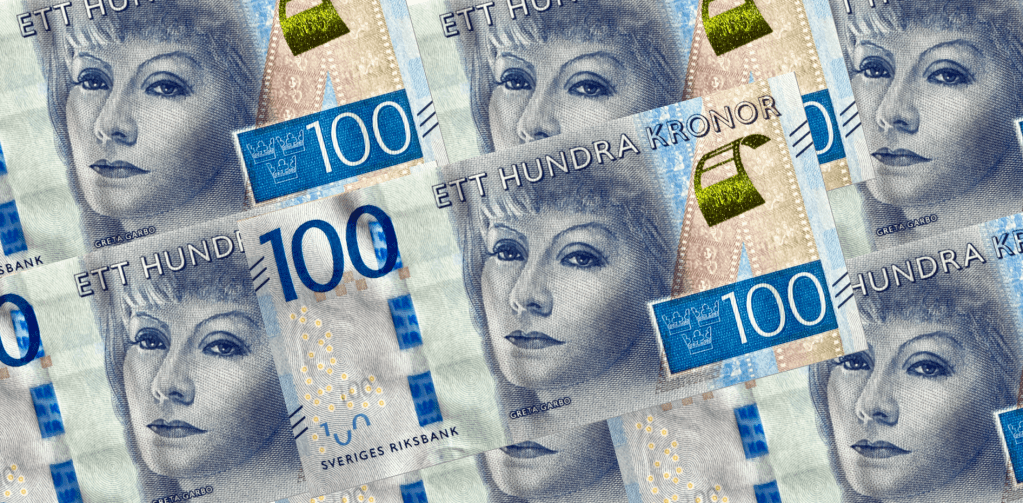
The Krona (SEK), is the official currency of Sweden and was first introduced in 1873 by the central bank, Riksbank. The following year, the Scandinavian Monetary Union was formed between Sweden and Denmark and a year later, Norway. The Union facilitated the introduction of a common currency (the krona/krone), for its members and was based on the gold standard. In 1914 when the Krona could no longer be converted to gold, the Union dissolved.
Today, the Riksbank issues Krona banknotes in the 20, 50, 100, 200, 500 and 1,000 denominations and all bear different sizes. The notes are constructed primarily of cotton material and are deemed “paper” money. Each note features an acclaimed 20th century Swedish figure (on the face), who drove cultural impact and gained popularity at home and abroad. The back of the notes feature environmental settings with ties to the persons depicted on the faces of the notes. Interesting facts: although Sweden has been a member of the European Union (since 1995), it has yet to adopt the Euro as its currency due to pushback on behalf of politicians as well as its populous. Furthermore, Sweden has been gradually reducing the volume of Krona (banknotes and coins), in circulation in a move towards creating a dual currency system, made up of physical and digital money. The Riksbank is exploring launching the E-krona as complementary to cash to be used as another method of payment. However no official launch date has been announced (yet) for the E-krona.
Obverse (2015 series)
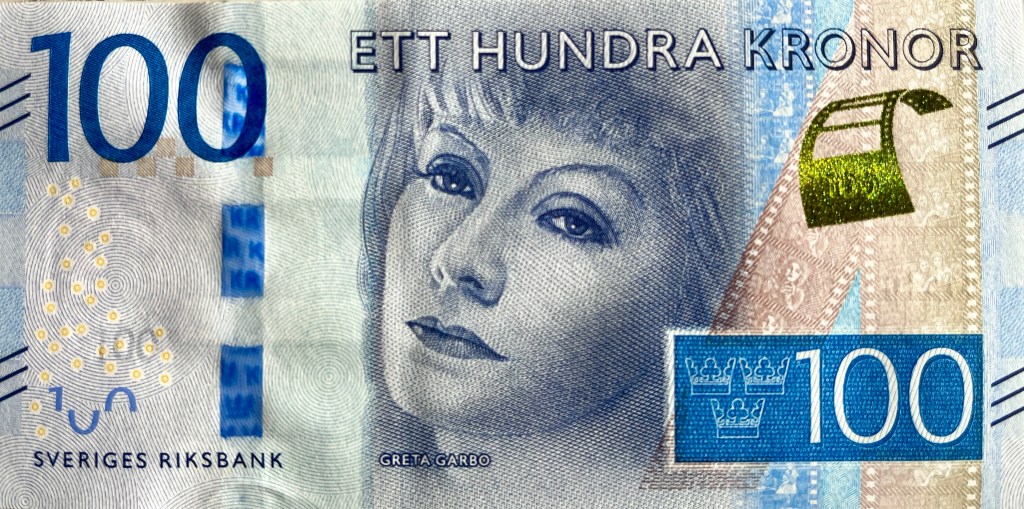
The 100 Krona is the fourth highest denomination among Sweden’s six banknotes and measures 133 x 66 millimeters. Its prevalent color is blue and depicts world renown film star Greta Garbo (1905 – 1990), considered fifth greatest female star of Classic Hollywood Cinema (by the American Film Institute). Garbo’s career started in silent films during the 1920s before transcending to Hollywood and sound films. She was known for playing characters of somber personas, a trait that not only depicted her roles onstage but also consumed her personal life. Although Garbo made 28 films, she ended her acting career at the age of 35 and shuddered herself from the public eye. She led an excessively private life, mostly out of touch with the outside world. She didn’t sign autographs and rarely gave interviews. She was nominated three times for an Oscar and yet did not attend the award ceremonies. In 1954 post retirement, she received an Academy Honorary Award for her work in film.
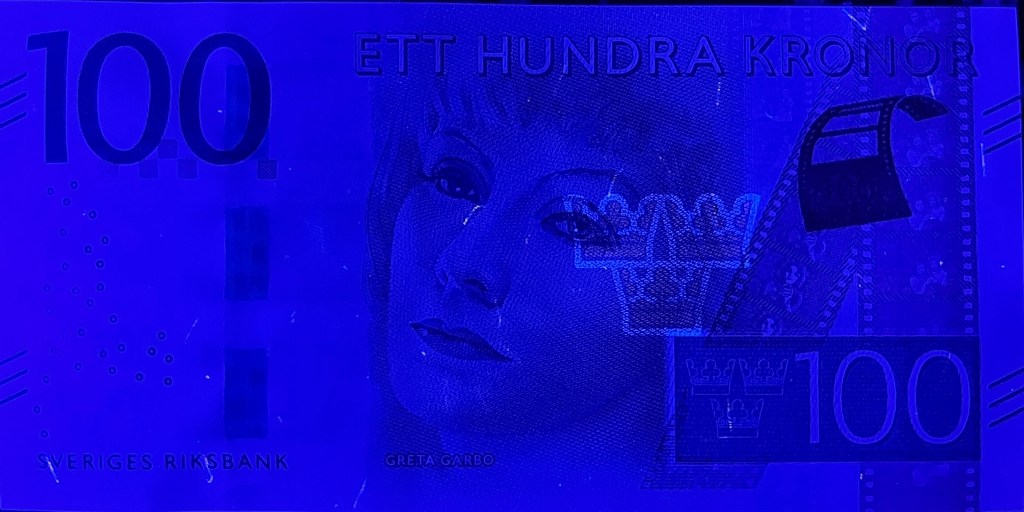
Aside Garbo’s pensively immortalized appearance on the obverse, images of filmstrips appear to her right further evolving the tale of her Hollywood stardom. The more prominent piece of filmstrip arching forward bears color shifting properties and alternates between gold and green (as the note is titled on its y-axis, in a toward-and-away motion). The note’s denomination is observed in the upper left and bottom right corners, accompanied by the inscription “ETT HUNDRA KRONOR” (One Hundred Krona), running ticker-tape like across its upper portion. The other inscription found on the bottom left “SVERIGE RIKSBANK” literally translates to “Sweden’s Realm’s Bank” or more commonly known as Sweden’s Central Bank. Just above this inscription is a watermark of Greta Garbo that appears when the note is held up to the light. Beneath the watermark the denomination can be seen twice, first in white and again in blue. A 0.5 cm wide windowed blue security strip runs vertically to the left of Garbo’s portrait and alternates images of KR and a royal crown (a nod to Sweden’s constitutional monarchy), when the notes is tilted on its y-axis. For a more amplified look at the royal crown, one can observe three of them within the blue rectangle bearing the 100 denomination in the bottom right corner.
A secondary security strip also running vertically manifests itself across Garbo’s right cheek as the note is held up to the light. Rounding out the main security features on the observe are micro text found within Garbo’s hair (depicting the names of several characters she played in her films), and also within the blue rectangle in the bottom right corner (the text there is “SVERIGESRIKSBANK” repeatedly. Finally, intaglio print, a commonly employed method of printing images and text on banknotes, offers a tactile texture of several characters such as Garbo’s portrait, the denominations, inscriptions and the three bars that appear on note’s margins as a way to discern its value versus other denominations.
Reverse
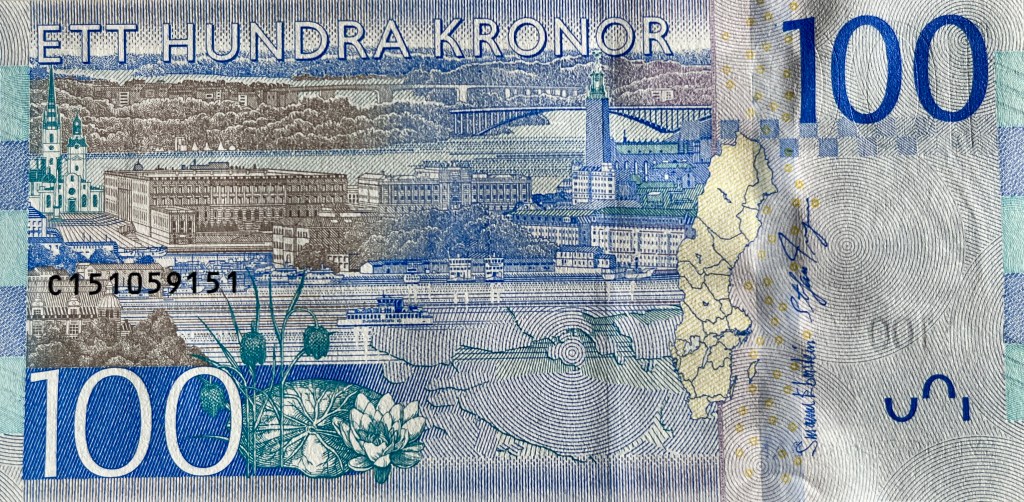
The reverse is mainly occupied by the urban setting of Stockholm, featuring the Parliament Building, the Royal Palace and City Hall. Also depicted are Lake Mälaren and the Baltic Sea. Towards the middle bottom portion of the note is a map of central Stockholm and the Södermalm district where Greta Garbo was raised. Breathing some life into the note’s motif are two popular provincial flowers, the White Water Lily (representing Södermanland), and the Snake’s Head Fritillary, representative of the Uppland province. Just to the right is a map of Sweden which appears to encroach on the watermark perimeter. Two opposing corners bear the note’s 100 denomination and its serial number is listed alphanumerically just once in black.
Some of the security features observed on the front, the likes of Garbo’s watermark and the continuous security thread, are also visible on the reverse as the note is brought up to the light. Microtext of “100” repeatedly can be viewed under magnification near the Sweden map, and “SVERIGESRIKSBANK” appears listed several times on a thin vertical edge that runs through the very same map.
Under UV Light

My Two Cents
The 100 Swedish Krona is a standout note marked by its timeless character and modern aesthetic. If only Greta Garbo’s endless gaze could speak… and to whom? Much like Garbo, the Krona as a currency is an outlier, non-conformist to the European Union’s standard and unconventional in the face of mainstream cash based societies (with the possible introduction of the digital version). With the gradual decrease of physical krona in circulation (as planned by the central bank), the rarity of the bills will only increase, and could make them even more appealing in the collector world. For now, the 100 Krona and its sister notes, can be deemed a portal into the past, shining a light on the luminary personalities they feature, as well as a signal to the future, and what a hybrid currency model could look like (when the E-krona eventually kicks in). Time will only tell us this part of the story.

 The Paper Money Guy
3 responses to “Sweden’s 100 Krona: Taking Note of a Cultural Icon”
The side story on Garbo made this more interesting to the non- specialists among us. Well written Alex!
LikeLiked by 1 person
Thanks James, appreciate the read! What a life, how did she even manage to keep out of the spotlight for so long, these days it would be virtually impossible.
LikeLike
Will look at it tomorrow. Just arrived in Paris yesterday. Exhausted! Bisous.
LikeLiked by 1 person