
With the Lunar or Chinese New Year now in full effect, I am dedicating this post to the auspices of the snake. The snake is the 6th animal (of 12), in the Chinese zodiac and symbolizes wisdom, transformation and growth. According to the Lunar Calendar, we are in the year 4723.
This new year officially kicked off on January 29. Celebrations lasted through February 12 and concluded with the Lantern Festival.
People born in the year of the snake are deemed intelligent, resourceful, resilient, and charming. If you or anyone you know were born in this zodiac sign, consider yourself or them lucky. They are among elite company. Some notable historical figures and modern cultural icons born in the year of the snake include: Nicola Copernicus, Mahatma Gandhi, Pablo Picasso, John F. Kennedy, Bob Dylan, Steven Hawkins, Taylor Swift and Kanye West. Side note: some of these folks are even featured on currency but we’ll save that for a future post perhaps.
Aside from some of these personalities, the snake itself is also featured on currency. It finds prominence on several banknotes throughout the world including the following examples.


China 20 Yuan (2025 Series)
Kicking things off is the commemorative Chinese 20 Yuan Note and most current example of a snake note. Introduced in December 2024, the polymer note is legal tender in China and can be utilized alongside non-commemorative notes. On the front it depicts a multi-colored snake and the People’s Republic of China emblem within the top left corner. Under the snake, sits the note’s 20 denomination right next to the “People’s Bank of China” characters. The denomination also appears in Braille for the visually impaired within the bottom left.
On the reverse is a scene of children attaching Spring Festival couplets to folk houses. This ritual is said to usher in messages of prosperity, good health and good fortune. A holographic pattern appears towards the lower part of the note surrounded by flowers. It is visible on the obverse as well. The year 2025 stands next to the president’s seal and the Chinese pinyin of the “People Bank of China”. This inscription is also observed in Mongolian, Tibetan, the and Zhuang languages.
Brazil 10,000 Cruzeiros (1991)
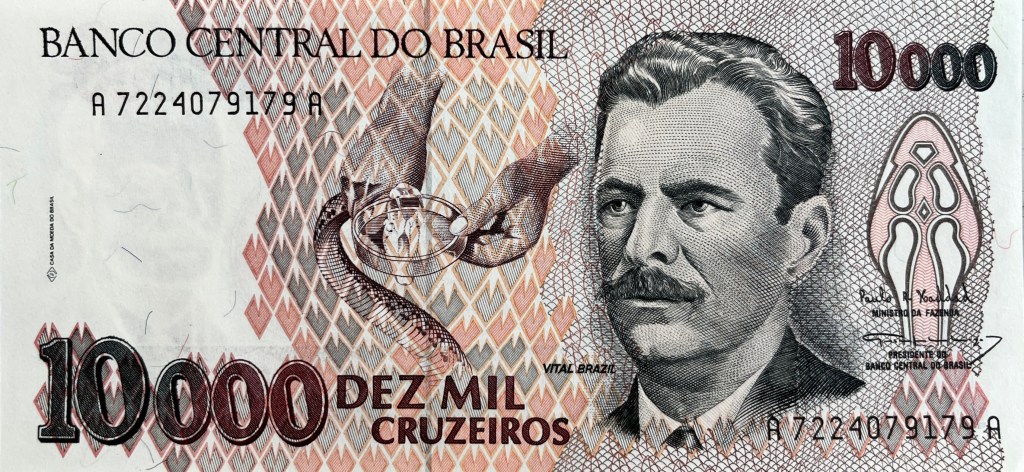
The next example hails from a different continent across the world. This 10,000 Brazilian Cruzeiros was issued by the Banco Central do Brasil as part of the Third Cruzeiro banknote series. These notes circulated between 1991 – 1994 and were made of paper material.
The 10,000 Cruzeiros became informally known as the “Serpent note”, featuring a venomous mussurana, or American tropical snake. On the obverse, the snake is being milked for its venom by the scientist and physician Dr. Vital Brazil, his portrait featured to right of the snake. Dr. Brazil became known for his work in the discovery and utilization of anti-venom to treat victims of snake bites. His contribution in this field drastically reduced the mortality rate of those bitten by snakes (from 25% to 2%). A serpent pattern is prevalent on most of the note’s face as homage to the reptile. After all, Brazil is home to the largest number of snake species in the world with over 400.
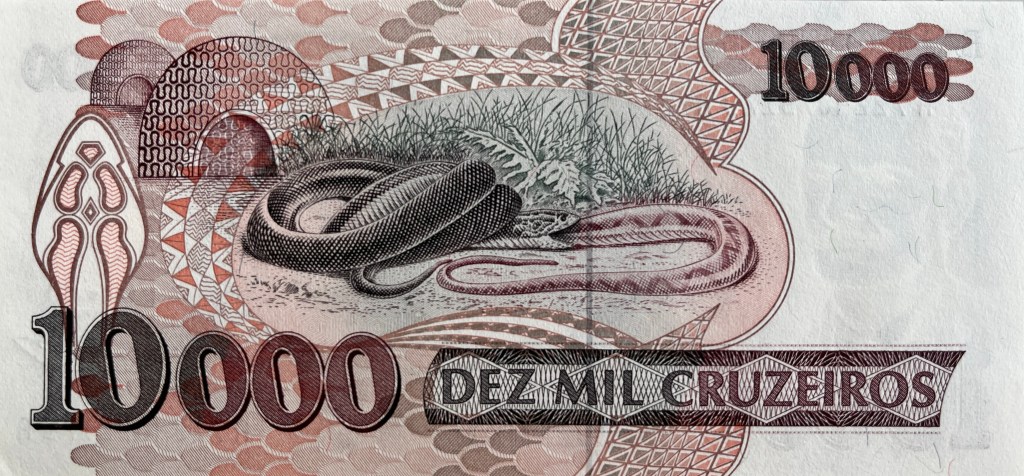
The reverse is dedicated to a dramatic snake eat snake vignette, a common occurrence in Brazil’s tropical habitat (in this case a mussurana ingesting a jararaca). Similar to the front, the snake scales motif continues here as well and helps complete the note’s canvas features.


Aruba 25 Florin (1990 Series)
The 25 Florin note was issued by the Central Bank of Aruba in 1990. It is made of paper material and its design was created by local artist Evelino Fingal. On the front, an Aruban Rattlesnake (Crotalus Durissus Unicolor), takes center stage. These venomous snakes are pit vipers, possessing the ability to hunt by sensing heat via their pit organs. The snake is endemic to the island and is among the rarest of rattlesnake species in the world. It is also critically endangered with only about 250 mature ones remaining in the wild.
The reverse of the note depicts pre-Colombian art featured on pottery.


Colombia 10,000 Pesos (2016)
The next example is presented by Colombia’s 10,000 Pesos, introduced in December 2016 by the Banco de la Republica (Colombia’s central bank). The note is made of paper material. On its face it features anthropologist Virginia Gutiérrez, a tree frog, and the Victoria Regia or water lily flower.
On the reverse, a depiction of the bio-diverse Amazon rain forest comes to life. The Amazon river undulates its way in the center transforming into a river snake. The Amazon River in Colombia is host to an abundance of Green Anacondas, likely the snake featured here. Anacondas are not venomous, they are constrictors and hunt by wrapping themselves around their prey squeezing the life out of them. Green Anacondas are considered to be the largest snakes in the world. Like its neighbor Brazil, Colombia is home to hundreds of snake species including many venomous and constrictor types.
The 10,000 Pesos note is vibrant in its cultural and bio-diverse depictions and also boasts vibrant security features as well. These include watermarks, color shifting ink, security strips and embossed printing, making it a prime example of modern banknote security.
Macau 10 Patacas (2013)
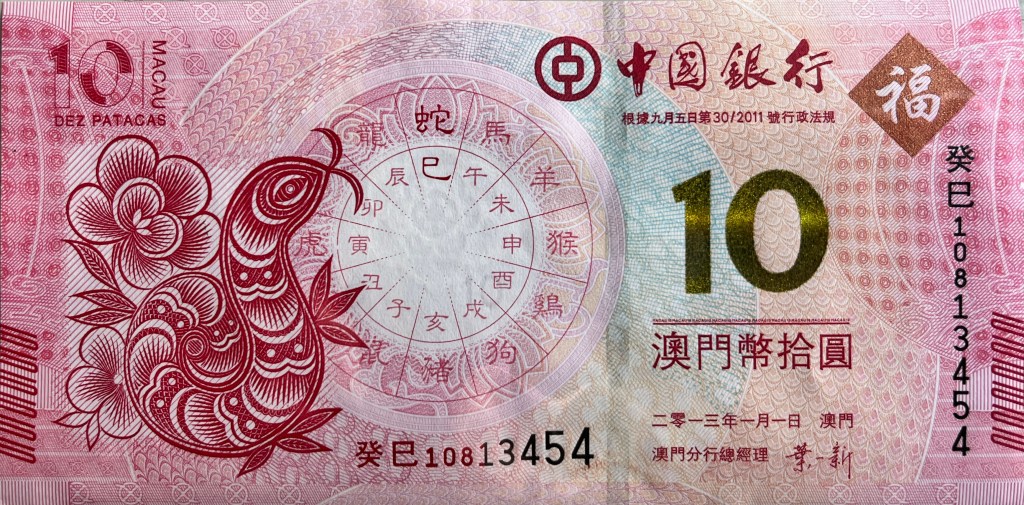
To round out the list, is Macau’s 10 Patacas Commemorative Year of the Snake Note. It is the second note within the full zodiac series released between 2012 – 2023. The note is made of paper material and serves as legal tender. Macau’s Patacas are issued by two commercial banks, the Banco Nacional Ultramarino and the Bank of China.
Macau is a special administrative region of China with its own governing and economic systems. For over 400 years Macau was a colony of Portugal. Today the region’s official languages are Chinese and Portuguese, which are both observed on its currency. Similar to China, Macau celebrates the Lunar Year and the zodiac currency series is a testament to this cultural phenomenon.
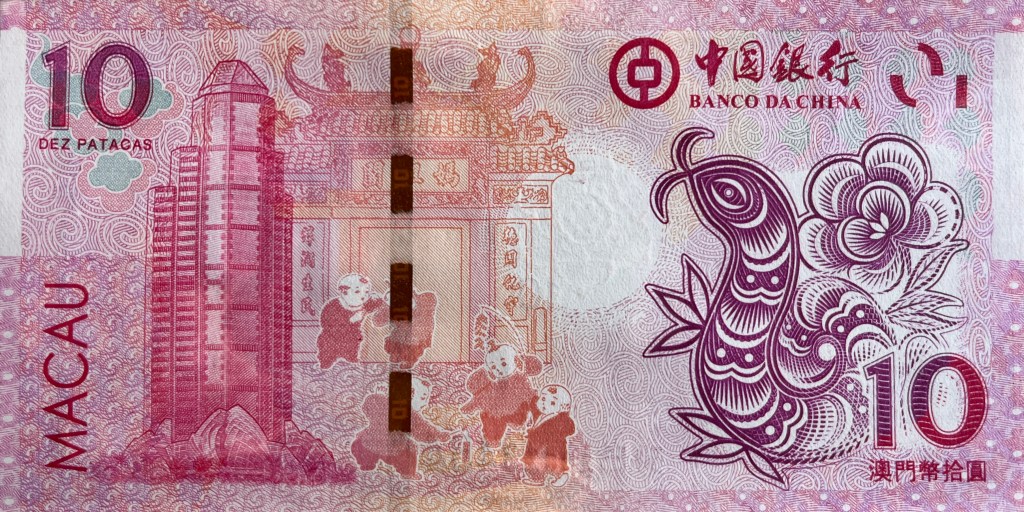
The front of the note depicts a snake along the Chinese zodiac and a lantern (next to the 10 denomination). Chinese characters are also observed translating to Bank of China. On the reverse, the Bank of China Macau Headquarters appear on the left. In the center are children with fireworks outside of the Temple of A-Ma. The temple, a UNESCO World Heritage Site, is one of the oldest in Macau built in 1488. To the right, the snake appears once again this time in purple.
Whether you are an ophiophilist or an ophidiophobe (love snakes or fear them), the world of paper money offers an approachable and fun way of appreciating the prehistoric animal. Cheers to the Year of the Snake!

 The Paper Money Guy
2 responses to “Year of the Snake: 2025 Take Note”
Don’t like snakes, but informative as usual!
LikeLiked by 1 person
Beautiful bills but not making me wanna go to Brazil anytime soon!
LikeLiked by 1 person