
In 1993 I traveled to Paris, France for the first time. My stay was not long, only a few days, but the memory is with me to this day. There’s nothing like Paris anywhere around the world and I was excited to have finally made it. I was almost 17 at that time and my passion for paper money collecting was budding.
A memory of French Francs from that era is the thinness of the paper they were printed on. It was flimsier than that of US notes. Some francs were smaller than the uniformly sized dollars I was accustomed to, while others almost doubled the size. Their artistic yet monochromatic motifs resembled museum like paintings. They exuded patriotism and told vivid tales of France’s history and the personalities the nation revered. I don’t exactly recall whether I held on to any francs and if so, what may have happened to them.
Thankfully for friends and family, a few French banknotes did make their way into my collection over the years. The note in focus for this entry is the 1997 issued 50 Francs.
The paper note was introduced by the Banque de France as a 1992 Series. It was accompanied by three other denominations: 100, 200, and 500. As the lowest denomination it was also the smallest in size. Coins accounted for the 1, 2, 5, 10 and 20 denominations. On January 1, 2002, the note was withdrawn from circulation to pave way for the introduction of the Euro.
Obverse
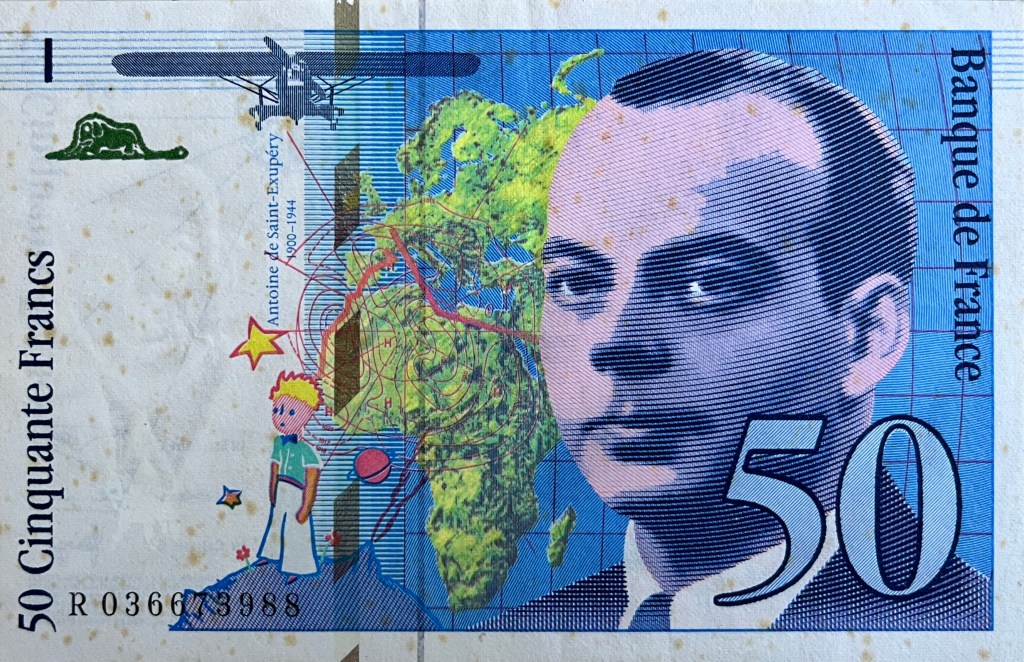
The face depicts Antoine Marie Roger de Saint-Exupéry (1900 – 1944), a map of Europe and Africa, and an illustration of The Little Prince. These are the most prominent features. In the top left portion, a Latécoère 25 airplane is observed. Next to it, is a green elephant inside a boa constrictor. A double take may be necessary to clearly observe this. What ties all of these things together?
For starters, Antoine de Saint-Exupéry was a French pilot. He flew commercially, carrying mail from Europe to North Africa and Latin America during the 1920s. Aside from taking to the skies, Antoine’s other passion was writing. He published several books in his lifetime, among them, The Little Prince. During World War II and France’s fall to the Germans, Antoine de Saint-Exupéry joined the French Air Force. He flew reconnaissance missions. It was on such a mission that he disappeared in 1944, never to be found again. The exact details behind his death are disputed and to some degree remain unproven. Some believe that he was shot down by German forces. Some of his personal effects and parts of his plane were recovered decades later, nowhere near his believed flight path. After his death, The Little Prince was published. It became his most notable work. The book sold in over 140 countries and was translated into over 300 languages.
The note’s face also shows a windowed security thread running vertically to the left of Saint-Exupéry’s portrait. A watermark of Antoine is located within the white panel beside the Little Prince. The issuing authority, “Banque de France”, and the denomination, “50 Cinquante Francs”, appear inscribed on opposite ends of the note. The note’s serial is seen horizontally just under the Little Prince’s feet.
Reverse
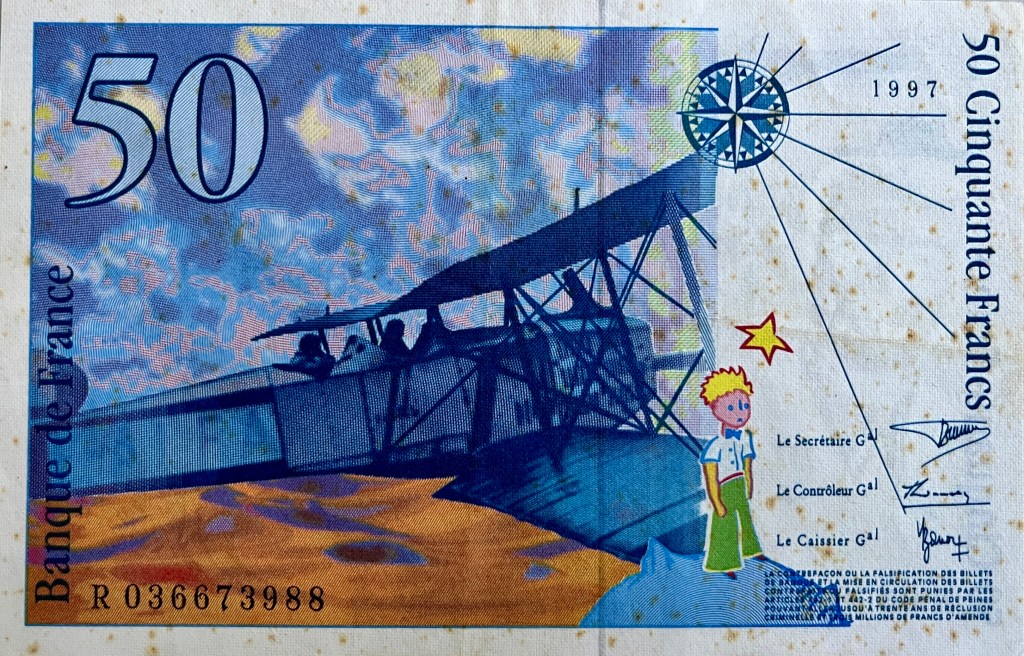
The back of the note prominently features the image of a Bréguet 14 airplane. This is the type Saint-Exupéry used during his mail running days. The plane is depicted flying over a desert. To the right, the Little Prince is seen standing on top of his planet of origin, in fact an asteroid. Above him, is a compass with rays emanating outwards. The note’s serial number, the inscriptions of the bank and the denomination are observed on this side as well. The signatures of the General Controller, General Cashier, and General Secretary are seen to the right of the Little Prince.
UV Light Activity
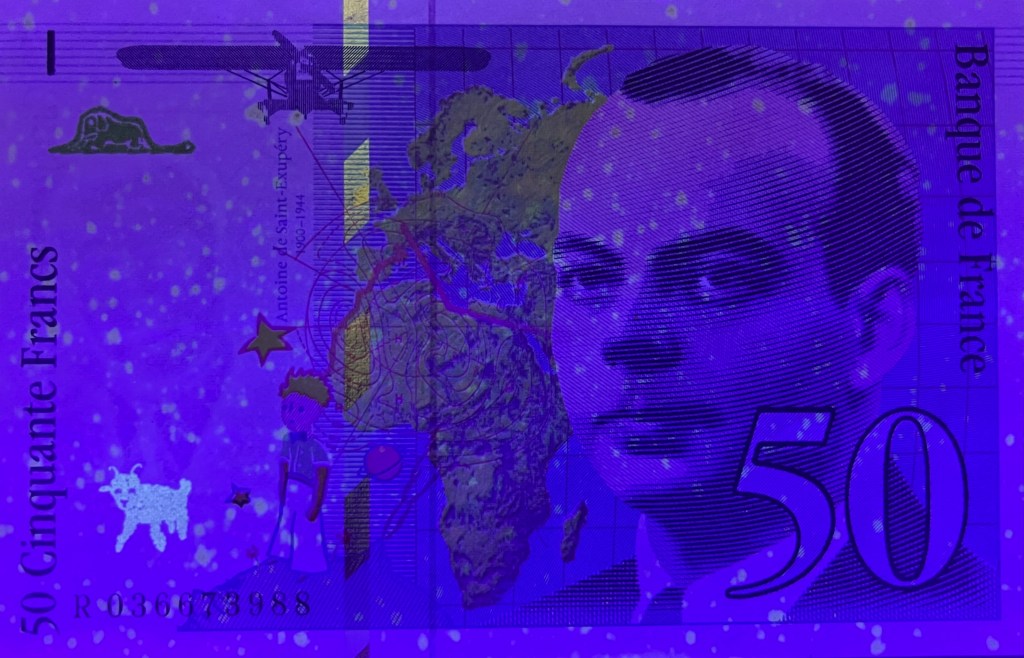
When subjected to UV light, the note produces a sheep in the watermark panel on the obverse. The sheep is another character from The Little Prince novella.
1992 Series Érror
A number of 1992 Series notes incurred a spelling error of Saint-Exupéry’s name. An extra acute accent or accent aigu appeared on the initial “E” on an unspecified number of bills. The error was corrected however the faulty notes that slipped into circulation became favored by collectors. Their value increased as a result.
The irony in all this is palpable. For anyone learning French, one can appreciate how challenging the grammar and application of correct accents can be. I can attest to this first-hand. In this case, however, even the French government fell victim to the misuse of its native tongue’s diacritical marks. The incident must’ve caused quite a stir.
My Two Cents
This 50 Francs note was a gift from my French mother-in-law who held on to it since the 1990s. Over the years, she had gifted me several notes. I believe this one was most special to her. It was apparent that there was a strong level of personal attachment to it. Her parents lived in France during WWII. I can only imagine how much closer the experience was for her. I remember her recounting stories of Saint-Exupéry’s heroism and his mysterious disappearance. They always intrigued me. The note continues to preserve that historical yet personal meaning, now as part of my collection.
But that is just one part of its legacy. The other is Saint-Exupéry’s literary contribution and the stories that are very much still alive today. The Little Prince is ingrained in France’s cultural identity, its school curriculum, and the Francophone influence around the world. A copy is somewhere on our bookshelf too!
This little prince of a note is a great reminder of the joy and discoveries that collecting currency can offer. The sky really is the limit.

 The Paper Money Guy
5 responses to “The Little Prince in my Collection: France’s 50 Francs”
Well done Alex. Had I known I would have saved a few notes from that era for you!
LikeLiked by 1 person
Thanks for kind thought and comment, James!
LikeLike
Wow!
LikeLiked by 1 person
I actually have one of the Petit Prince note. I keep it preciously my because I find it beautiful. The acute accent business on the E is a strange story. In my days, you were not supposed to put an accent on capital letters. But nowadays they do…new rules which I don’t approve of.
LikeLiked by 1 person
Great to hear you held on to another Petit Prince note!
LikeLike