With each turn of the new year and winter setting in, I can’t help but dream of a tropical escape. There was a time when the Caribbean would satisfy that dream by way of a 1-week getaway.
Aside from the warmer climate and clear blue seas, I always enjoyed the cultural elements of the destination as well. Part of that would stir up my curiosity and passion for the local currency. The pursuit of crisp banknotes in their respective environments was always fun yet somewhat challenging. Some occasions paid off while others beg for a return visit and second try.
Several Caribbean nations have issued new currency series within the past few years, making a mid-winter escape even more enticing.
For this post we will take a look at some of my favorite tropical island notes spanning several decades. Our island hopping will start with Jamaica and make its way to a few other destinations as well.
Jamaica $1 (1986 Series)
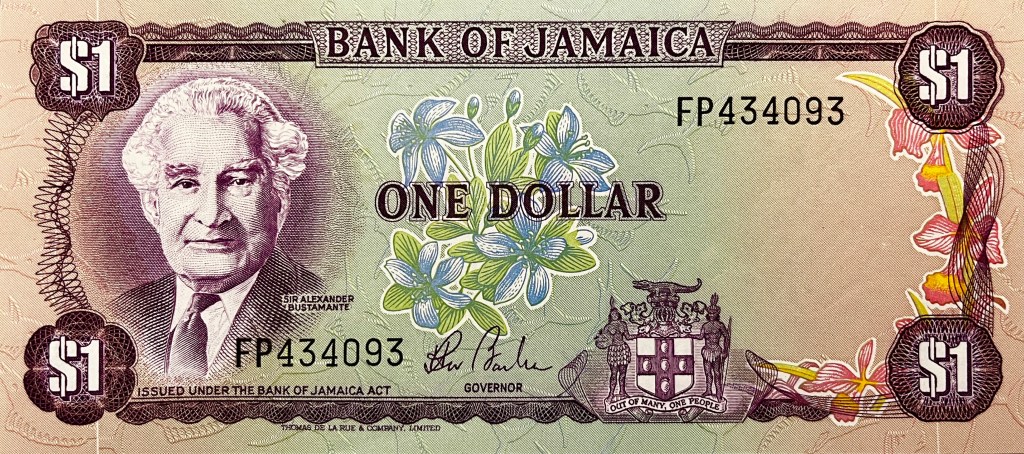
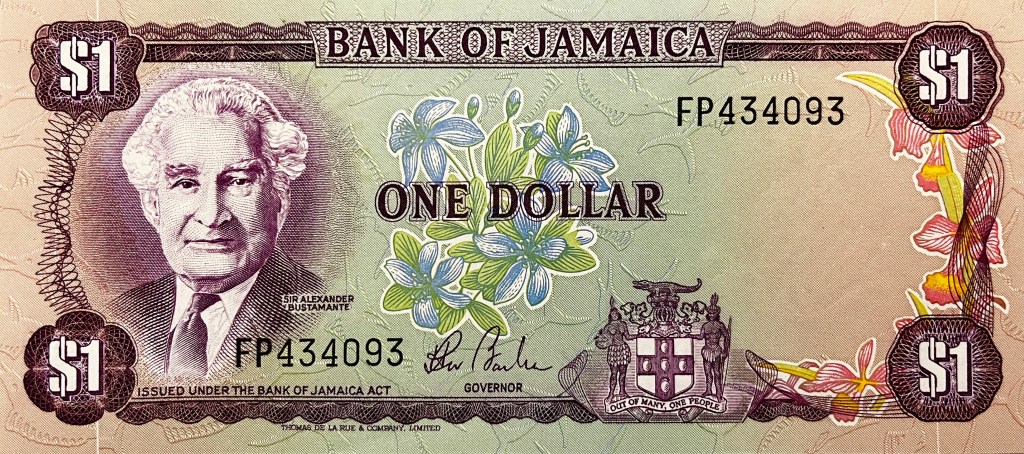
The $1 (JMD), note was first introduced by the Bank of Jamaica in 1969. It was issued as part of a new series that included four other denominations. They were $0.50, $2, $5, and $10. The $1 measured 143 x 63 mm and was made of cotton material, as were the other denominations. It featured the portrait of Sir Alexander Bustamante (1884 – 1977), on its obverse. As the first Prime Minister of Jamaica, he began serving his role on Jamaica’s independence Day, August 6, 1962. He served until 1967.
The national flower of Jamaica, Lignum Vitae, is depicted in the center of the note. The “wood of life,” as the name translates to, is symbolic of the Jamaican people’s strength and resilience. Its natural beauty bears blueish purple flowers. The wood from the Lignum Vitae tree was historically used for medicinal purposes and building ships.
Jamaica’s coat of arms is observed towards the bottom right bearing the nation’s motto: “Out of Many, One People“. Next to it, is a watermark of a pineapple. It symbolizes Jamaica’s openness and hospitality. It also signifies the nation’s agricultural prowess. Fun fact: there are five pineapples on Jamaica’s coat of arms.
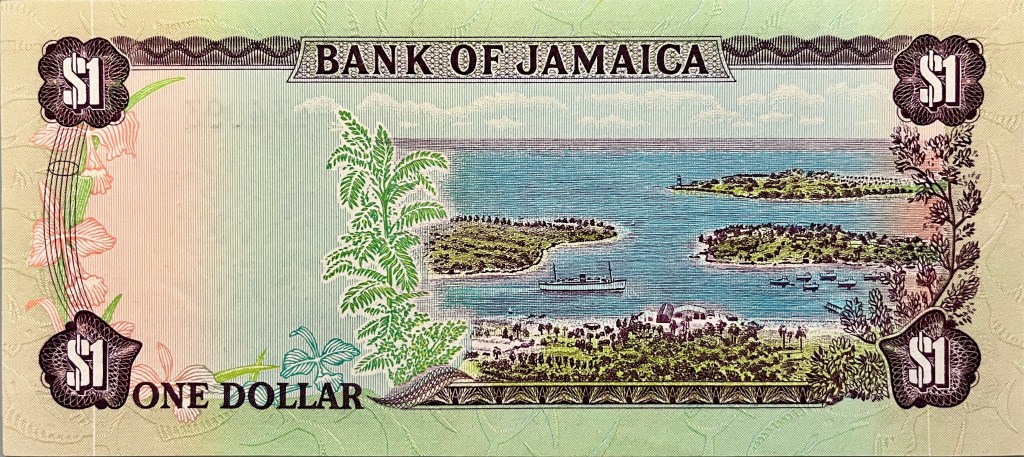
On the reverse, the Lignum Vitae and watermark panel are seen on the left. The adjacent scene is that of an open harbor, on a clear and calm day with a vast horizon. The note’s dominant pastel hues induce a welcoming tropical mood.
The $1 note circulated for about 20 years. It was replaced by a coin in 1990 and the notes were subsequently withdrawn from circulation by the late 1990s.
Aruba 10 Florin (2003 Series)
The Florin (AWG), is Aruba’s official currency and is issued by the Central Bank of Aruba. Aruba introduced the Florin as a newly self-governing nation in 1986. It started with five banknote denominations that included 5, 10, 25, 50 and 100. The colorful series was created by local artist Evelino Fingal. He drew inspiration for his designs from the island’s pre-Columbian artifacts and local flora and fauna. All denominations shared the same dimensions of 147 x 66 mm and were made of paper material.
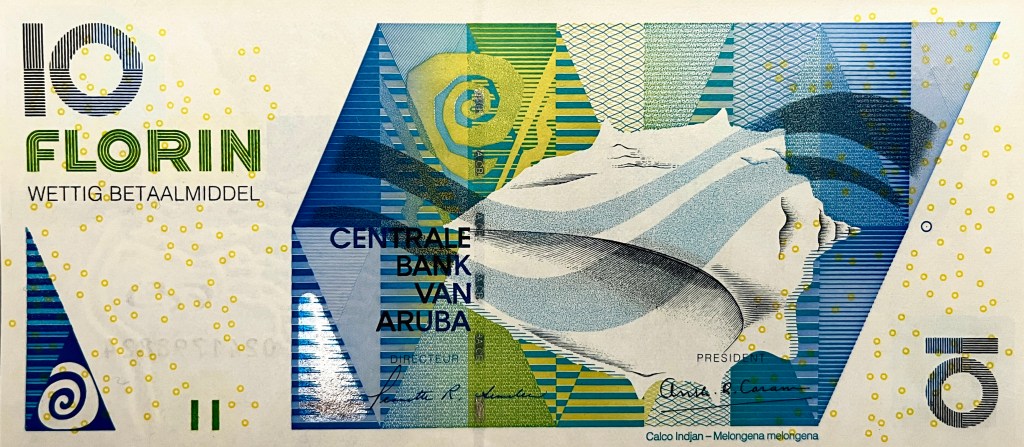
On its obverse, the 10 Florin features a Caribbean Crown Conch, showcasing the beautiful shell against a colorful tapestry. A watermark is located on the left panel underneath the 10 Florin label. It depicts a Watapana or Divi Divi tree whose undulating shape is symbolic of the island’s year round trade winds. As a result, the tree naturally sways in a southwesterly direction, a trademark of Aruba.
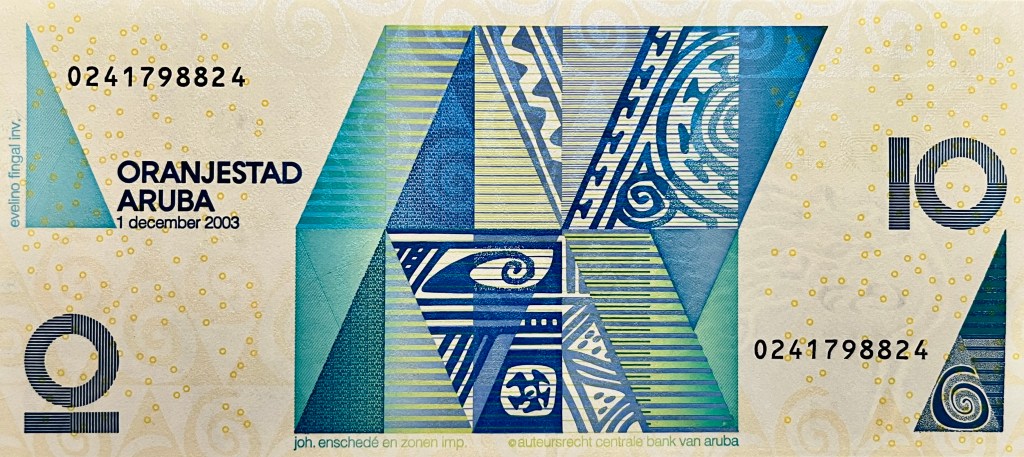
The back of the note is more modest and depicts a pre-Columbian ancient Aruban pottery design. The note’s serial number and denomination is located in opposite corners. The blue hue is consistent with the front, and conjures up an image of the azure waters of Aruba.
In 2019 the Central Bank of Aruba introduced a new series of banknotes thus replacing the previous one.
Eastern Caribbean $1 (1965 Series)
The Eastern Caribbean Dollar (EC $), is the official currency of 8 members of the Organization of Eastern Caribbean States. The members include Anguilla, Antigua & Barbuda, Dominica, Grenada, Montserrat, Saint Kitts & Nevis, Saint Lucia, and Saint Vincent & The Grenadines. Of the 8 members, 6 are fully independent nations. The remaining 2 members, Anguilla and Montserrat, are considered British Overseas Territories.
The Eastern Caribbean Dollar was introduced in 1965 and replaced the British West Indies Dollar. Today it is issued by the Eastern Caribbean Central Bank.
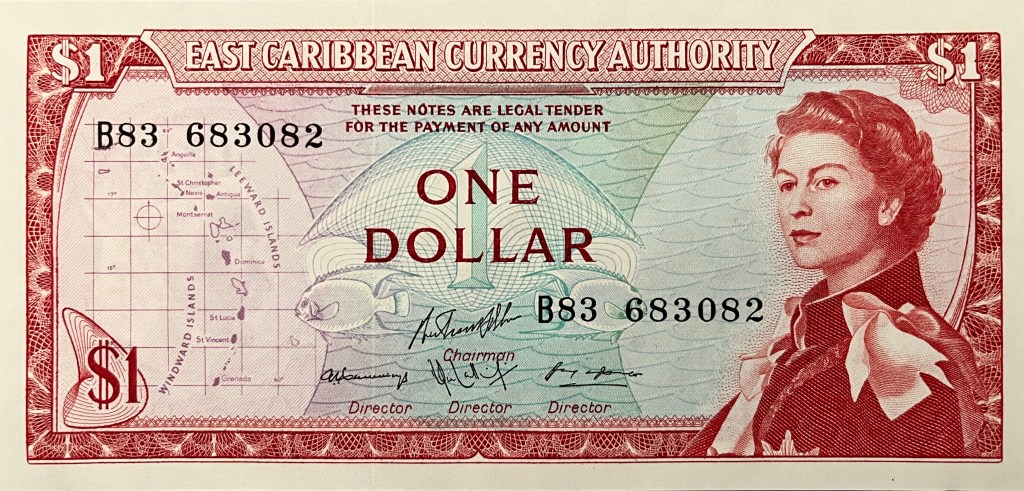
The 1965 Series $1 note was issued by the Eastern Caribbean Issuing Authority. It featured the portrait of British Monarch Queen Elizabeth II (1926 – 2022). She was 39 when the note was issued. However, the portrait is based on a painting of her at the age of 30. In the center of the obverse, there are two angelfish pictured on a greenish backdrop of a sea. On the left panel, there is a map of the Eastern Caribbean Islands. It is divided into two groupings, the Leeward (downwind) and Windward (upwind) islands. The Leeward Islands are characterized by drier and calmer weather versus the Windward Islands that see more rain and wind.
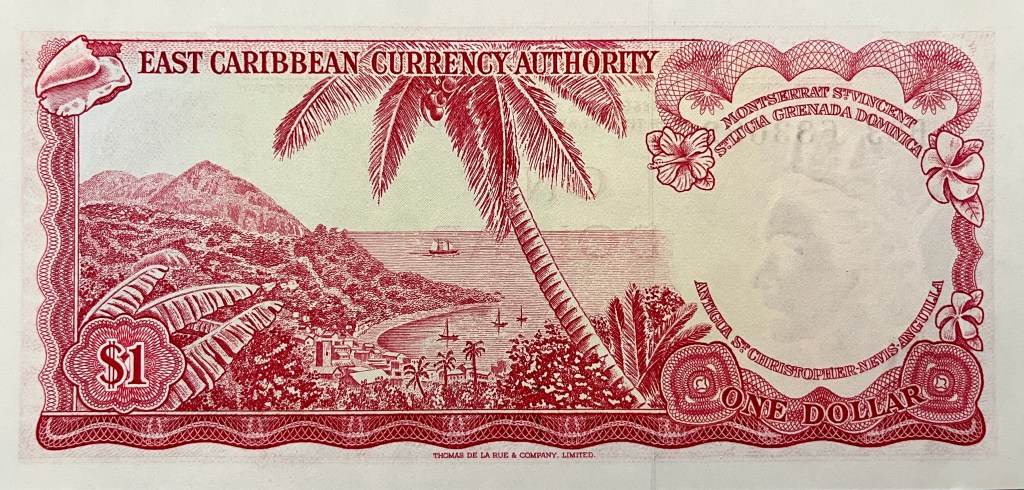
On the reverse is a coastal view with a harbor, thought to be that of Saint Lucia. In the foreground, there are palm trees and other vegetation. Beyond the harbor, there are mountains and the vastness of the open sea. On the right panel there is a watermark of Queen Elizabeth II outlined by local flowers. A conch shell sits in the top left corner symbolizing the local culture.
The 1965 series $1 notes were replaced by $1 coins in 1982, and by 1985 they were withdrawn from circulation. The current series (2019), are made of polymer substrate (and feel like plastic), and are presented in vertical orientation.
Cayman Islands $1 (C Series)
The Cayman Islands Dollar (KYD or CI$), is the official currency of the islands. It is issued by the Cayman Islands Monetary Authority and was introduced in 1972. It replaced the Jamaican Dollar which served as the official currency for both territories due to their interdependence.
The $1 note is the smallest denomination in its series followed by $5, $10, $25, $50 and $100. Interestingly, a $40 note was released in 1974, the highest denomination at that time. It eventually fell out of circulation due to its unpopularity. However, it remained highly sought after by collectors fetching several times its face value. The $1 note is constructed from paper material. It measures 156 x 66 mm. This is a uniform dimension for the other denominations.
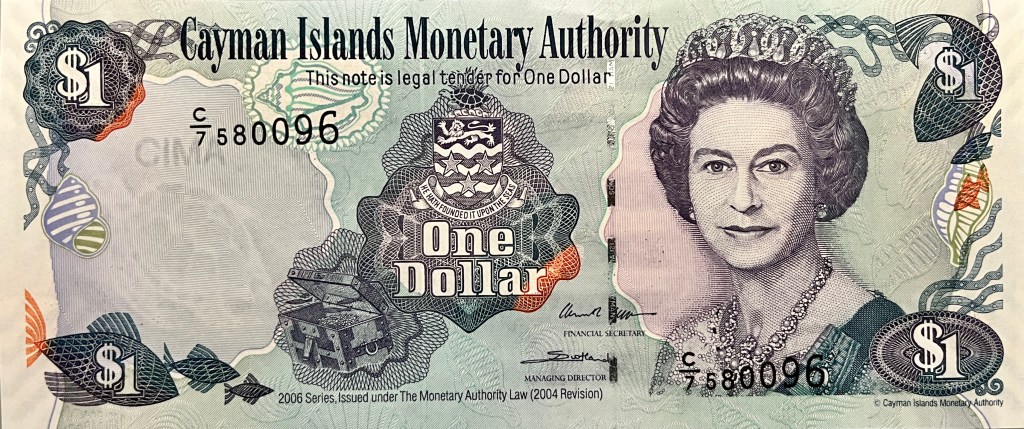
The colorful blue face depicts a portrait of Queen Elizabeth II (1926 – 2022). The islands’ Coat of Arms is at the center. A lively marine motif is also seen, teeming with fish, shells and an open treasure chest. The denomination is located in all four corners. A watermark featuring a turtle occupies the left panel.
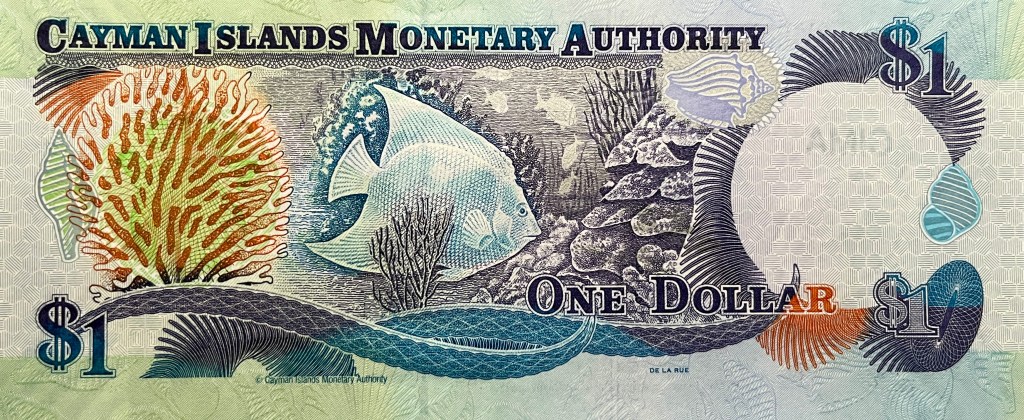
We are treated to a bright underwater vignette on the reverse. It comprises coral reefs, conch shells, and a large fish in the foreground. Extra fish are seen in the backdrop swimming alongside coral reefs.
The latest and current series of Cayman Islands banknotes, D Series, was issued in 2010.
My Two Cents
With the winter blues in full effect and a recent ice storm accentuating the impact, I am full on Caribbean dreaming. How nice would an escape to a tropical island be right now? While that may not happen right away, I can still lose myself in these colorful, warm and inviting notes. The escape is immediate even though only in spirit.
Is a tropical getaway in your near future? I hope so, and if you come across any notes, hold on to them for future winters!

 The Paper Money Guy
6 responses to “Caribbean Dreaming: Warm & Colorful Notes”
So what’s your island get away this winter Alex? Interesting article!
LikeLiked by 1 person
Good question! Not sure I have a good answer though..
LikeLike
Wow, great article! Beautiful artistic design of these colorful banknotes.
LikeLiked by 1 person
Thanks, they are very lively.
LikeLike
Excellent article as usual. I admire your detailed explanations and pictures. I always read your stories with great interest. Please keep up the good work.
LikeLiked by 1 person
Many thanks for the feedback, love hearing you’re enjoying the content! Will keep it up!
LikeLike