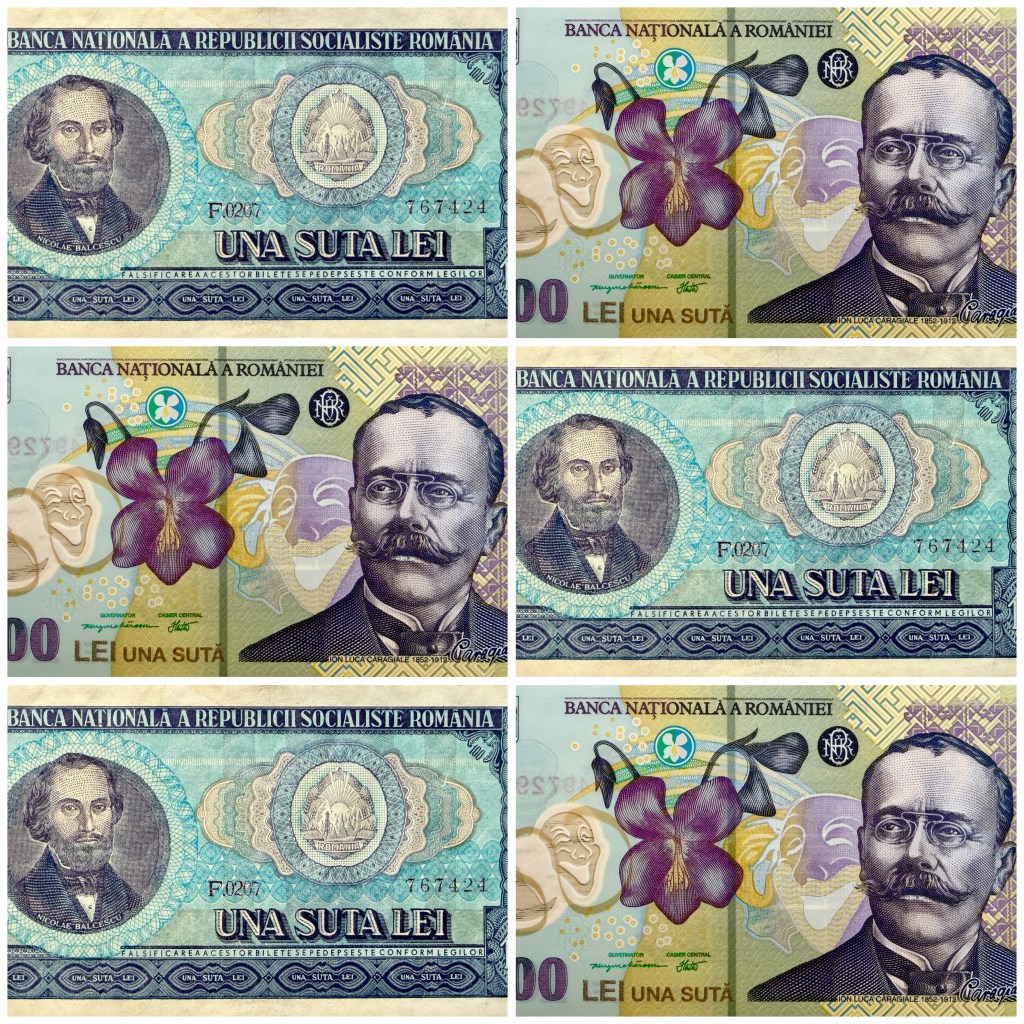
The local postman would come to deliver mail at my grandmother’s house, including her pension, in cash. To this day, the scent of his leather bag infused by myriads of letters, permeating the room, stays with me. The mail would gather in a small pile on the kitchen table, followed by the careful counting of several blue banknotes, which were then carefully handed over to my grandmother.
This ritual occurred once a month and at times I was there to witness it. The notes were 100 Lei, and flashed a bright blue face and bust of Nicolae Bălcescu. This was in the mid 1980s during the socialist republic of Romania.
The Romanian Leu
The Leu/Lei (RON), is the official currency of Romania and is issued by the Banca Naționala a Romaniei (National Bank of Romania). The Leu was instituted in 1867 as coins under King Carol I, Romania’s first monarch. The first Lei banknotes were issued in 1877. Since then, the Leu has undergone several redenomination phases due to political shifts and hyperinflation. The word ‘leu” means lion. The term was derived from the Dutch leeuwendaalder (lion thaler), a silver coin featuring a lion. The coins circulated in the 17th century throughout the Balkans.
For this post, we’ll lock in on two 100 Lei notes, the one from my childhood (before leaving Romania), and the current non-commemorative issue. When I grew up in Romania, the country was under communist rule run by a dictator named Nicolae Ceauşescu. In 1989 a bloody revolution ousted his communist regime and set the nation on a path to transition. As a result, Romania shifted to a multi-party parliamentary republic, a political system modeled after western democracies.
100 Lei – Obverse (1966 Series)
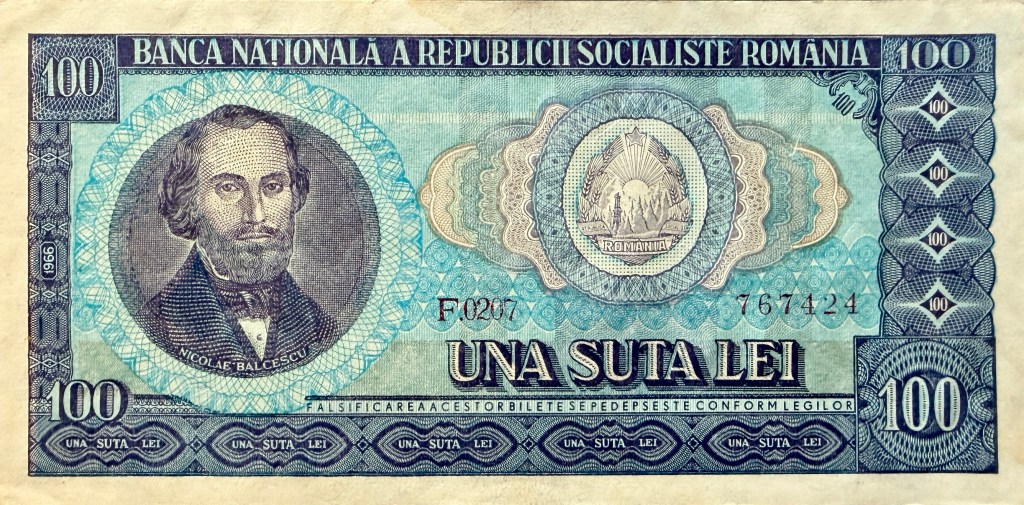
The 1966 issued noted is made of paper and measures 153 x 75mm. It was the largest denomination in the series which included the following notes: 1, 3, 5, 10, 25, 50 and 100. You read that correctly, there was a 3 Lei banknote in that series (not your everyday denomination). The blue face depicts a portrait of Nicolae Bălcescu (1819 – 1852). Bălcescu was a man of many devotions, he was a journalist, a historian and a patriot. His main contribution, that ultimately shaped his legacy, was that of revolutionary leader. He aspired to free Romania from foreign rule and establish an independent, democratic nation state.
To Bǎlcescu’s right, is the communist era coat of arms. It is characterized by a forest mountainous landscape, a rising sun, an oil derrick and a red star. The note’s serial number is depicted in red and its denomination is seen in each of the four corners. The inscription “UNA SUTA LEI” translates to One Hundred Lei. The issuing authority was the National Bank of the Socialist Republic of Romania. Micro printing and fine design detail can be observed throughout the note, serving as a counterfeit deterrent.
100 Lei – Reverse (1966 Series)
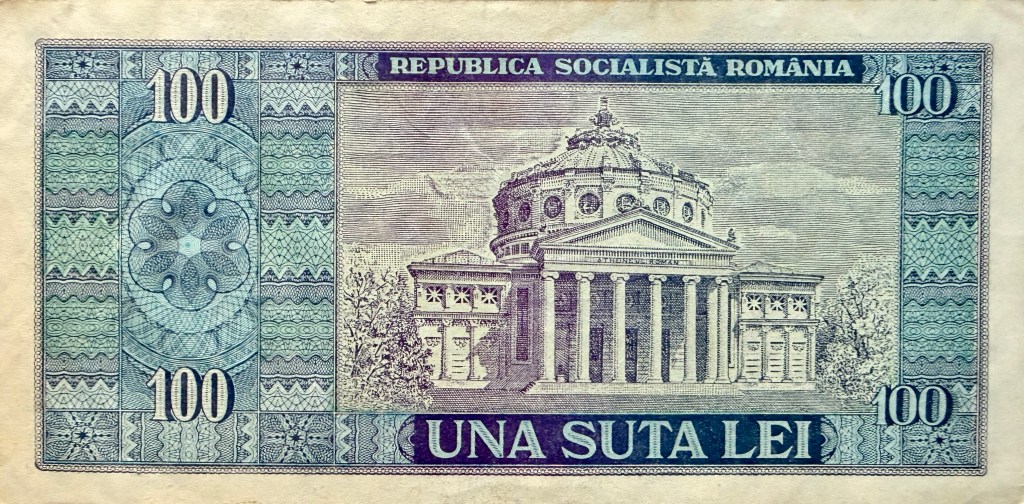
The reverse depicts the Romanian Athenaeum in Bucharest in its neoclassical architectural style. The athenaeum or concert hall was opened in 1888 and has become a national landmark, defining of the capital and Romanian culture. Framing the image of the athenaeum, is a continuous guilloché pattern, symbolic of folk embroidery. Consistent with the obverse design, the denomination lives in the four corners. The inscriptions “REPUBLICA SOCIALISTǍ ROMÂNIA” (Socialist Republic of Romania), and “UNA SUTA LEI” are observed as well.
100 Lei – Obverse (2018 Series)
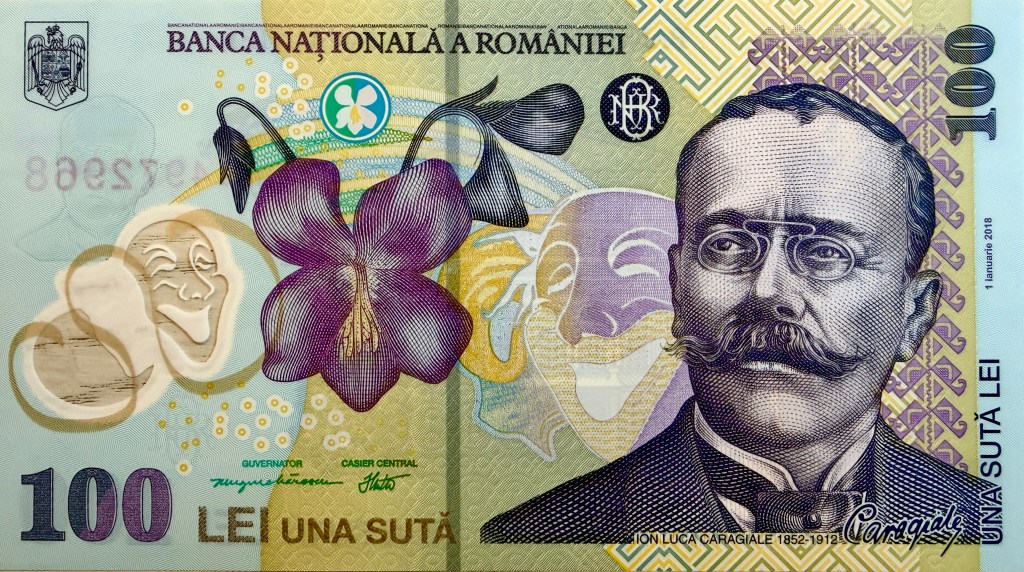
Many differences can be observed between the 1966 100 Lei and the current issue. For starters, the 2018 series is a polymer note. Romania was the first European nation to transition its currency from paper to polymer in the late 1990s. The note’s overall design and colors offer a more artistic take on the currency compared to its socialist antecedent.
The 100 is the 3rd largest banknote denomination (after 500 and 200); the complete series includes the following notes: 1, 5, 10, 20, 50, 100, 200, 500. It measures 147 x 82mm. It is the same size as the 100 Euro note, a signal for Romania’s possible future adoption of the EU currency.
The note carries a dominant blue background, reminiscent of the 1966 series. That however is where the similarities conclude. The face depicts the portrait of Ion Luca Caragiale (1852 – 1912), Romanian playwright, poet, political commentator and theater manager. Caragiale cemented himself as the greatest dramatist in the Romanian language. His specialty was satire. His comedies delved deep into the social and political impacts of modernity during 19th century Romanian life. Fittingly, two theater masks are also present and bookend a blue violet.
The issuing authority is the “BANCA NAȚIONALǍ A ROMÂNIEI” or the Romanian National Bank. Its “BNR” acronym is visible next to Caragiale’s head. The Romanian coat of arms is located in the top left corner. Underneath it is a watermark of Caragiale. The note’s denomination lies diagonally in opposite corners and the inscription “UNA SUTǍ LEI” can be observed as well.
A prominent metallized vertical security strip can be seen near the center of the note. The signatures of the Governor and Chief Cashier are located underneath the blue violet.
100 Lei – Reverse (2018 Series)
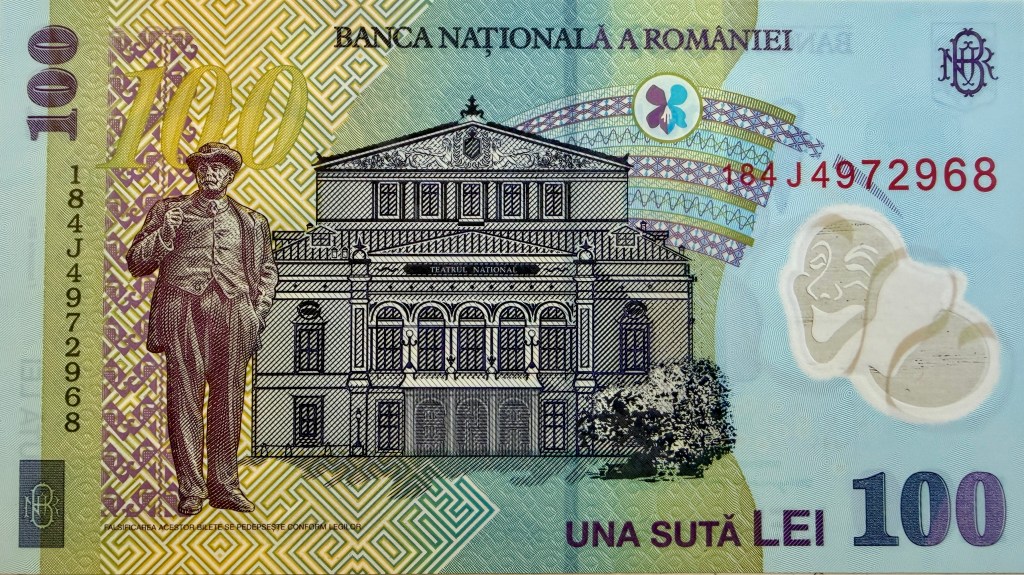
The note’s reverse sets the stage with an image of the Old National Theater of Bucharest and a statue of Ion Caragiale. Caragiale was director general of the theater and many of his plays premiered there. A theater mask from the obverse can be seen in the right panel underneath the serial number (printed in red). The number is also listed vertically in black on the left panel. The “100” denomination occupies opposing corners and the “BNR” stamp is located in the bottom left.
My Two Cents
These 100 Lei notes are 52 years apart, a lifetime in many senses. For some (the older Romanian generation), the paper note may be a relic of a dark past, Romania’s time under communist dictatorship. It was one of Eastern Europe’s most repressive regimes that tainted the nation for decades to come.
For me, it’s also a reminder of a distant time and place filled with childhood memories. Many of which remain warm and longing like those of being at my grandparents’ house.
The current notes tell a different story. They represent a new nation, one bound by a peoples’ free will and a future they have a say in. They reflect a rich cultural heritage and influential national figures, like Ion Caragiale.
Side by side as they stand in my collection, the notes also represent a clash in political ideologies of past and present, one that history reflects upon as a cautionary tale. They can’t help but stir up mixed emotions, from the fog of my childhood to a deep yearning for a return visit to Romania.

 The Paper Money Guy
One response to “Exploring Romania’s 100 Lei: A Journey Through Time”
Love the blue of that old bill!
LikeLiked by 1 person