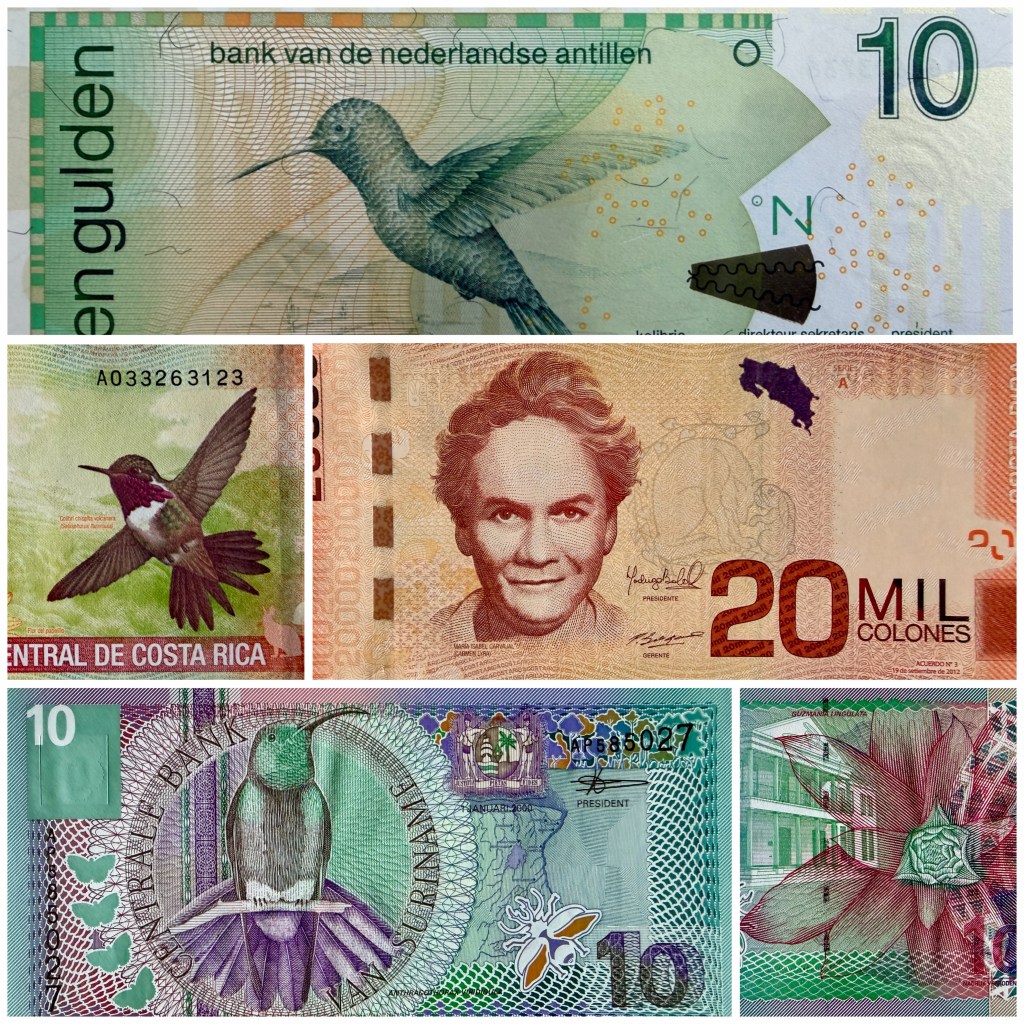
My wife recently purchased a hummingbird feeder and set it up in our backyard. I’m not quite sure how successful these contraptions are, but I share in our kids’ enthusiasm for the project. We all look forward to seeing these wonders of nature in close proximity. With early May upon us, the timing for their return to our neighborhood (after wintering in the warmer climate of Mexico), is just right.
For this post, I decided to explore banknotes that feature these colorful and intrepid fliers.
Endemic to the Americas, hummingbirds are fascinating creatures that seem to defy the laws of physics. They can fly forward and backward, hover, and flap their wings up to 80 times per second. Nectar is their primary source of sustenance and they must refuel every 10 minutes to sustain their fast metabolism.
There are over 300 species of hummingbirds making them the second largest bird group (behind flycatchers). They come in different colors, some are iridescent and some are as vibrant as the flowers they feed on. Their average lifespan is 3 to 5 years. Each time we see one, a jolt of excitement seems to run through us.
Curaçao & Sint Maarten 10 Gulden (2006 Series)
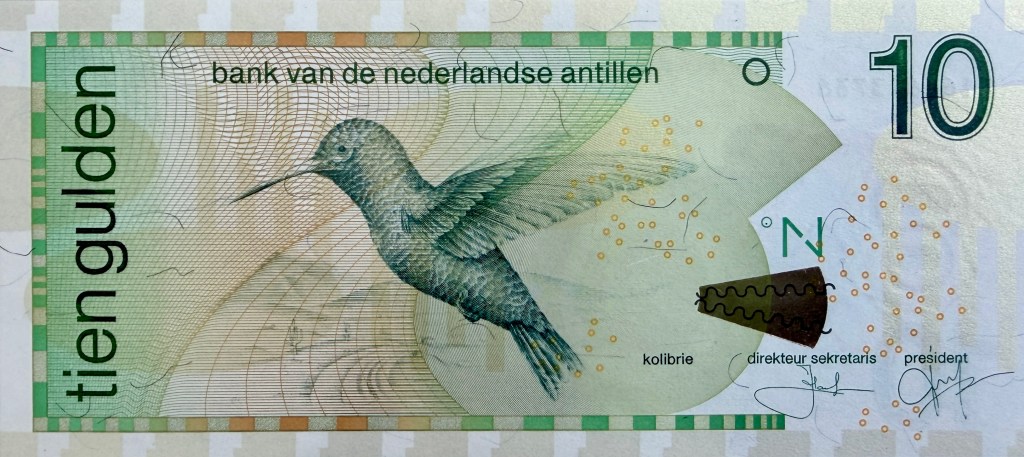
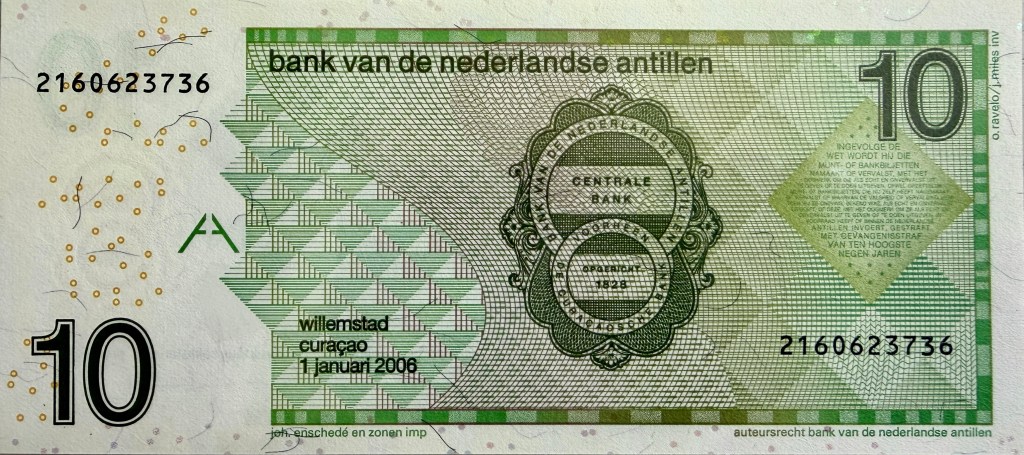
Issued by Bank van de Nederlandse Antillen (Central Bank of Curaçao & Saint Martin), the 10 Gulden note was part of the 1998 – 2016 series that pays homage to local birds. While in circulation, the notes were known as Netherlands Antilles Guilders (ANG). The paper note measures 147 x 66 mm and was the smallest denomination followed by 25, 50 and 100.
Its bright green face depicts a Purple-throated Carib or hummingbird that inhabits the Lesser Antilles region of the Caribbean. This region is comprised of two dozen island states (forming an arc) from the Virgin Islands downward towards Trinidad & Tobago and the ABC islands (Aruba, Bonaire & Curaçao), off the coast of Venezuela.
Interestingly, male and female adult Purple-throated Caribs have the same plumage colors. The male’s bill however is less curved and shorter compared to the female’s curvier longer bill. They primarily feed on nectar from flowering trees complemented occasionally by insects and spiders.
The inscriptions on the note are in Dutch, the official administrative language of Curaçao and Sint Maarten. Several security features include fibers, miniature dots, and a gold foil within the bottom right. Next to the foil, sits a watermark of the central bank’s logo.
The reverse features the seal of Bank van de Nederlandse Antillen. Security micro fibers and miniature dots are seen on this side as well.
Collectors should note that as of July 1, 2025, Netherlands Antilles Guilders are no longer legal tender, having been replaced by the Caribbean Guilder.
Costa Rica 20,000 Colones (2012 Series)
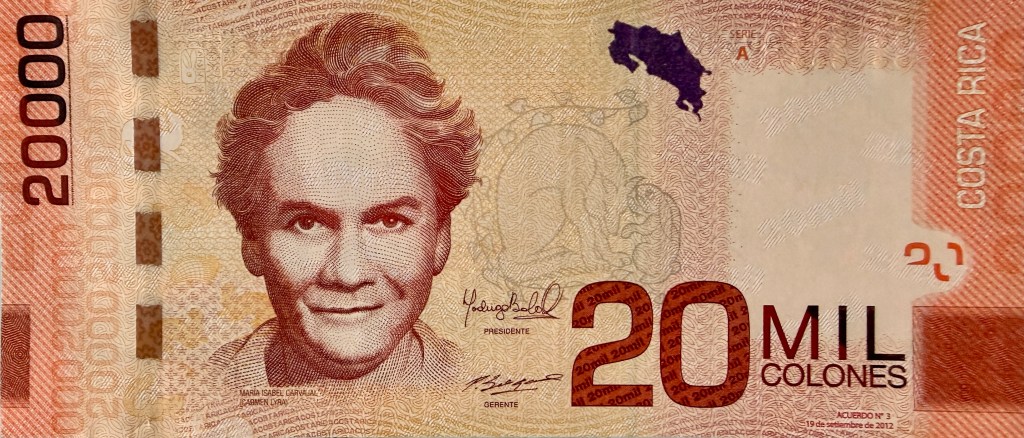
Costa Rica’s 20,000 Colones banknote (CRC), is issued by Banco Central de Costa Rica (Central Bank of Costa Rica). The obverse depicts the portrait of María Isabel Carvajal (1887 – 1949). Carvajal is also known by her pen name Carmen Lyra. She was an educator, writer and political activist. Known for many impactful accomplishments throughout her life, Lyra founded Costa Rica’s first Montessori school.
To her right, is an image of a rabbit and a coyote, two characters from her book “Cuentos De Mi Tía Panchita” (Tales of My Aunt Panchita). Just above the image is a map of Costa Rica. A watermark of Carmen Lyra rests on the right panel. To Lyra’s left is a prominent windowed security band that reacts when subjected to UV light.
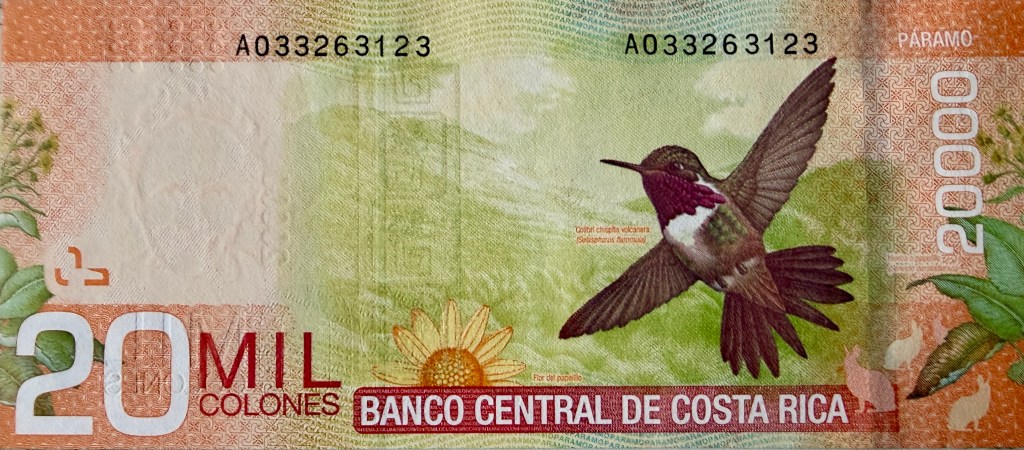
The note’s reverse brings more vibrancy to its backdrop. The orange hue blends with scenery of a mountainous landscape enveloped in green. A Chispita hummingbird captures our attention in full flight. The “chispita” or little spark hummingbird points to two diminutive species found throughout Costa Rica and Panama. They are among the smallest and most ethereal birds around, weighing approximately 2-3 grams. They fly at high altitude, one species prefers the habitat near volcanoes (at 6,500 – 11,500 feet), while the other lingers at lower altitudes (between 3,000 – 6,500 feet). Both species feed on small flowers (and tiny insects), often visiting up to two thousand daily.
A yellow Papelillo flower is seen to the left of the hummingbird and several rabbits occupy the bottom right corner. The serial number is listed twice toward the upper margin. On the bottom, the inscription “BANCO CENTRAL DE COSTA RICA” is seen. A vertical iridescent stripe is seen towards the center of the note depicting birds. This element comes to life under UV light.
Between 2020 and 2021, Costa Rica’s central bank introduced a new series of Colones banknotes in polymer format. The new series replaced the previous paper notes which are no longer considered legal tender as of May 2026.
Suriname 10 Gulden (2000 Series)
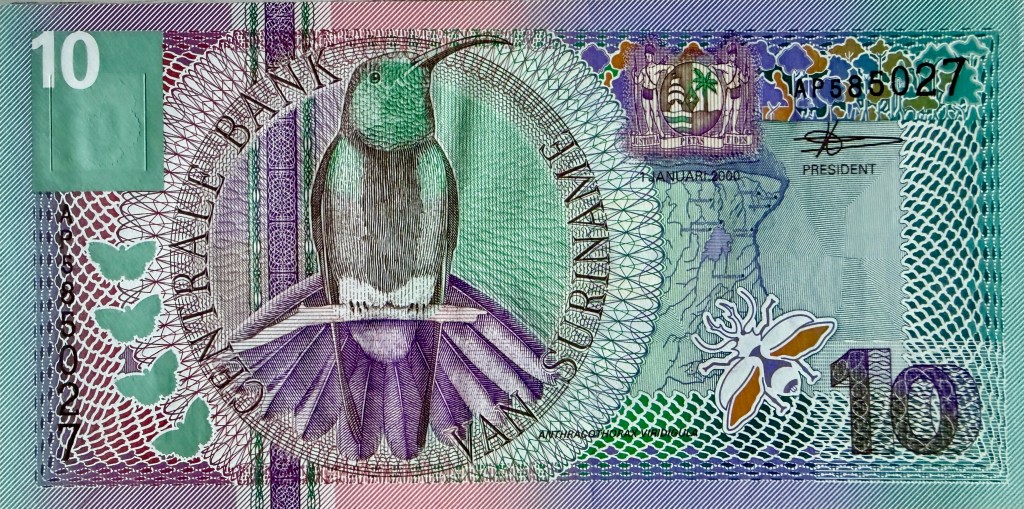
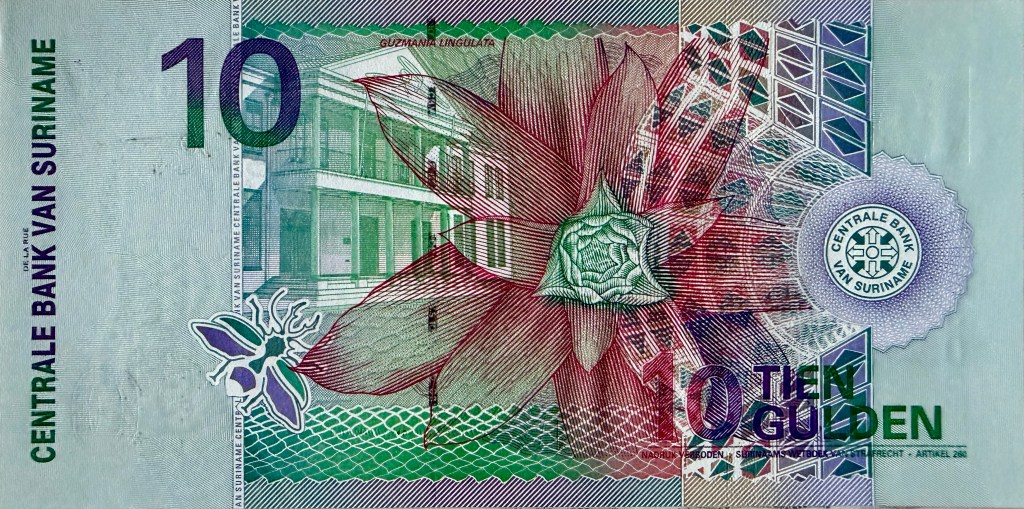
Suriname’s bright 10 Gulden (Guilder) note was issued by Centrale Bank Van Suriname (Central Bank of Suriname). The paper note measures 140 x 70mm. It was part of the 2000 Series which included the following denominations: 5, 10, 25, 100, 500 and 1,000. The note’s inscriptions are in Dutch, Suriname’s official language.
On the face is a prominent depiction of a Black-throated Mango or hummingbird, perched on a twig. The bird is found around forest edges, open woodlands and gardens. They are known for their high-pitched calls. Frequently emanating from males, the calls are used for territorial defense and communication. Four Nymphalid butterflies are seen to its left. To the right of the hummingbird stands Suriname’s Coat of Arms. Underneath it is a map of the country.
A Stag Beetle is seen as a security feature or registration device intended to verify the note’s authenticity. It is located next to the 10 denomination in the bottom right corner. In between the note’s ascending serial number and the numerical denomination, is a watermark. It depicts the central bank’s building.
The reverse of the bill is dominated by a Scarlet Star flower, endemic to rainforests in South America. In the background stands the building of the Central Bank of Suriname. The bank’s logo sits next to the flower. The Stag Beetle is seen on this side as well just off the watermark panel. When the note is held to the light, the beetle’s full image comes into clear view. This note is no longer legal tender as the Suriname Gulden was replaced by the Surinamese Dollar in 2004.
So far we covered three notes, three countries and three different types of hummingbirds. There are definitely more, so stay tuned for Part 2, coming soon!

 The Paper Money Guy
2 responses to “Tiny Wings, Big Bills: Hummingbirds on Paper Money (Part 1)”
Great!
LikeLiked by 1 person
Wow! More information than I ever had on hummingbirds. You are becoming more of a botanist than a numismatist…
LikeLiked by 1 person