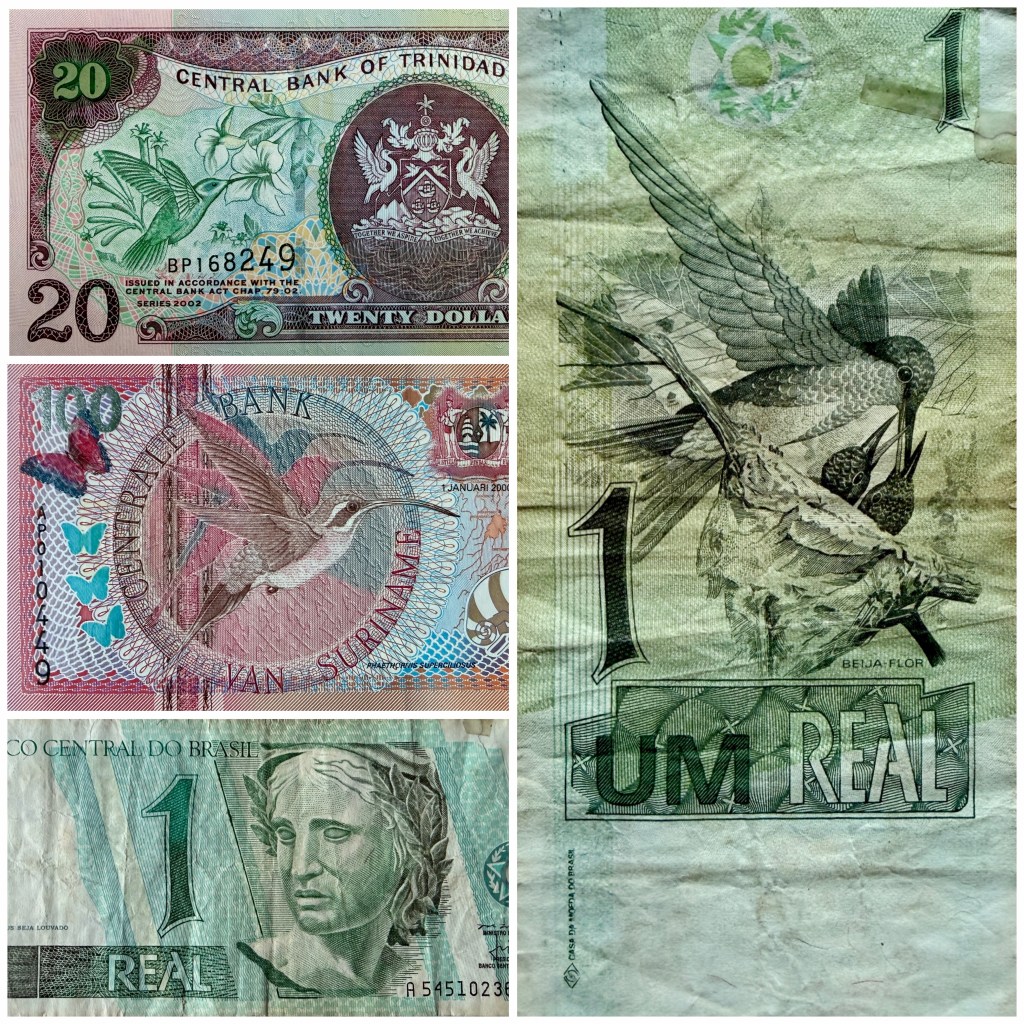
Suriname 100 Gulden 2000 Series
Picking up right where we left off, we’ll check out a few more notes in this post depicting hummingbirds. Next up, is another Suriname note from the 2000 series. Issued by Centrale Bank Van Suriname, the 100 Gulden paper note has the same dimensions, 140 x 70mm, as the 10 Gulden note featured in Part 1.
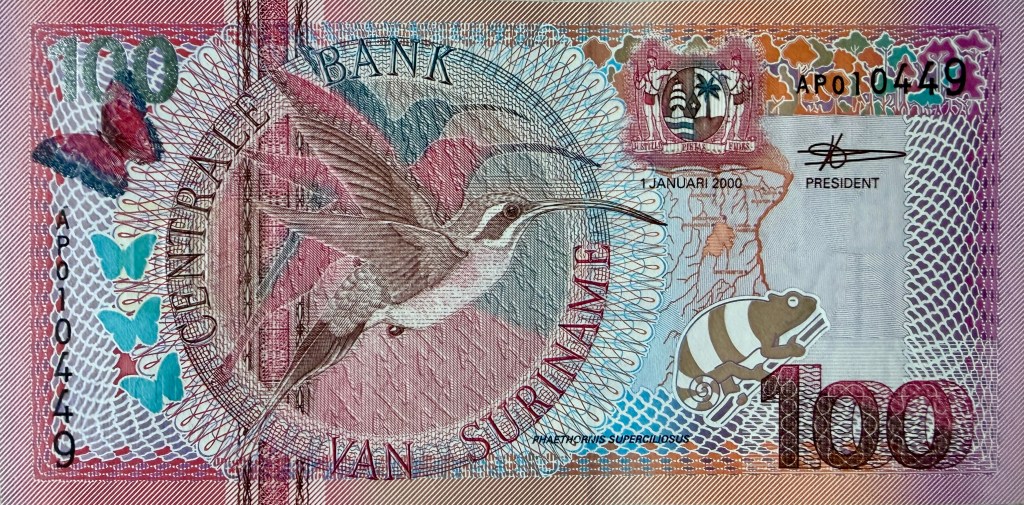
There are strong parallels between the layout and design of the two Gulden notes. The 100 depicts a Long-Tailed hermit (hummingbird) on the obverse just left of center. The long tail serves multiple purposes, it attracts females and also acts as a rudder providing flight maneuverability. Another noticeable feature is its long bill. This explains why the hummingbird is often interchangeably referred to as the Long-Billed hermit. These features contribute to the bird’s size (typically 13 – 15 centimeters), making them among the larger birds in the hummingbird family.
Long-Tailed hermits are prevalent in Suriname, the Guyanas, Venezuela and Northern Brazil. Their diet consists of nectar and small insects found across vast swaths of the rainforest. Unlike other hummingbirds (that tend to stick to nearby food sources), Long-tailed hermits fly a “trapline”, or a sequence of food sources whose pattern they’ve committed to memory.
To the hummingbird’s left, are four Nymphalid butterflies, three of which turn florescent when the note is subjected to UV light. Suriname’s Coat of Arms is located to the right of the Long-Tailed hermit just atop a map of the country. Right underneath is a stylized chameleon pointing to Suriname’s biodiversity. It too activates under UV light, serving as another security feature.
On the right panel is a watermark of the Central Bank of Suriname Building and the inscription CBVS. The serial number appears in ascending characters in two locations as does the note’s denomination.
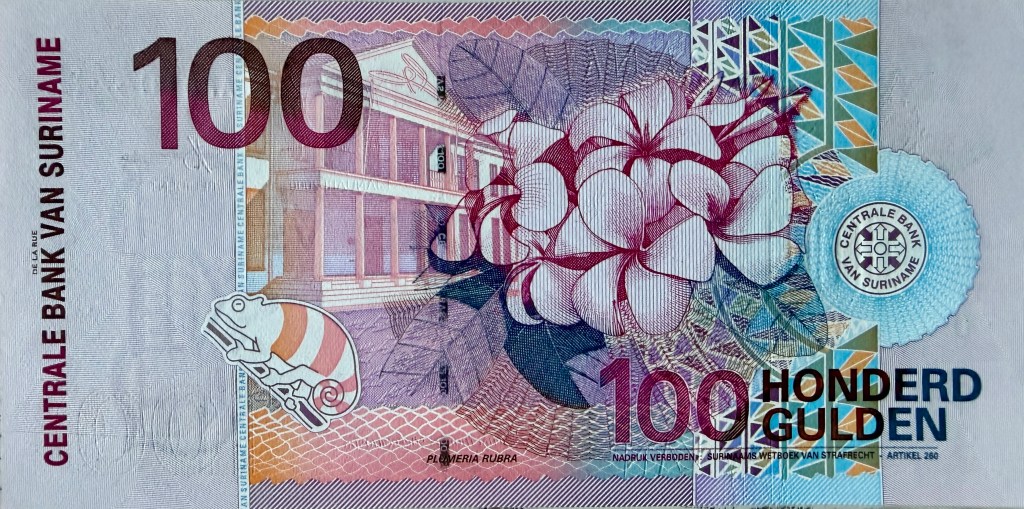
The back of the 100 Gulden note depicts the Central Bank Building and a Red frangipani flower, symbolic of renewal, resilience and natural beauty. The bank’s logo is seen to the right of the flower. Looking closer to the center of the note, we notice a vertical windowed security thread with the inscription CBVS. Just to the left is the stylized chameleon that was introduced on the note’s obverse. The “100” denomination appears in two locations on this side of the note as well.
Trinidad & Tobago $20 2002 Series
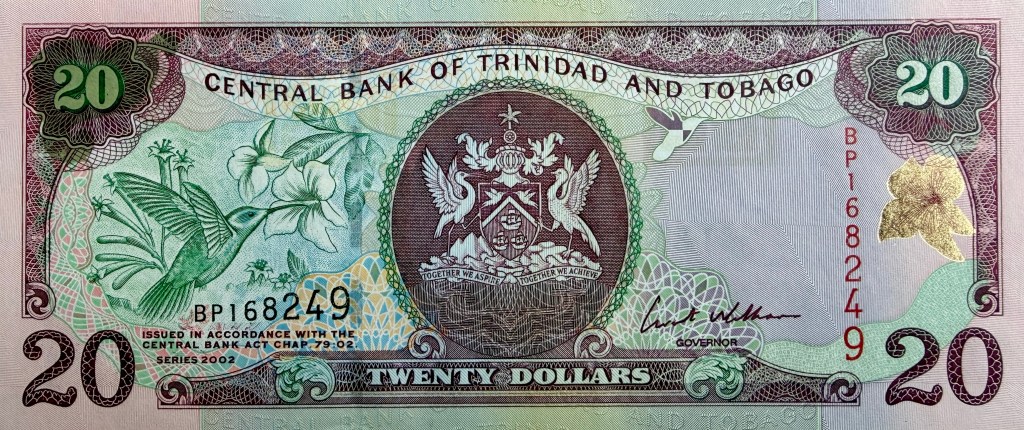
Issued by the Central Bank of Trinidad & Tobago, the $20 paper note was the fourth denomination in ascending order in that series. It measures 155 x 65 mm and carries a dominant purple motif punctuated by various depictions in green.
Trinidad & Tobago’s Coat of Arms sits prominently at the note’s center. The backdrop shows a tropical setting with a White-Tailed Sabrewing (hummingbird) drinking nectar from a hibiscus flower. The hummingbird and hibiscus flower also appear on the right panel in different formats. The hummingbird is seen as a registration device (an image that appears complete when the note is held up to the light, by combining the images printed on both sides of the note) and the hibiscus appears as a gold foil patch. Both serve as security features. Within the same right panel area, there is also a watermark of the hummingbird. The serial number appears horizontally and vertically in ascending characters.
The islands of Trinidad & Tobago are known as the “Land of Hummingbirds” being home to 19 recorded species. The White-Tailed Sabrewing is the largest hummingbird found in Tobago, growing up to 13 cm. The males boast more color than females and are mainly dressed in vibrant green with an iridescent blue patch on their throat. Nectar serves as the main food source for these hummingbirds, supplemented by the occasional small insect. Once believed to be threatened as a species, today the White-Tailed Sabrewing is thriving.
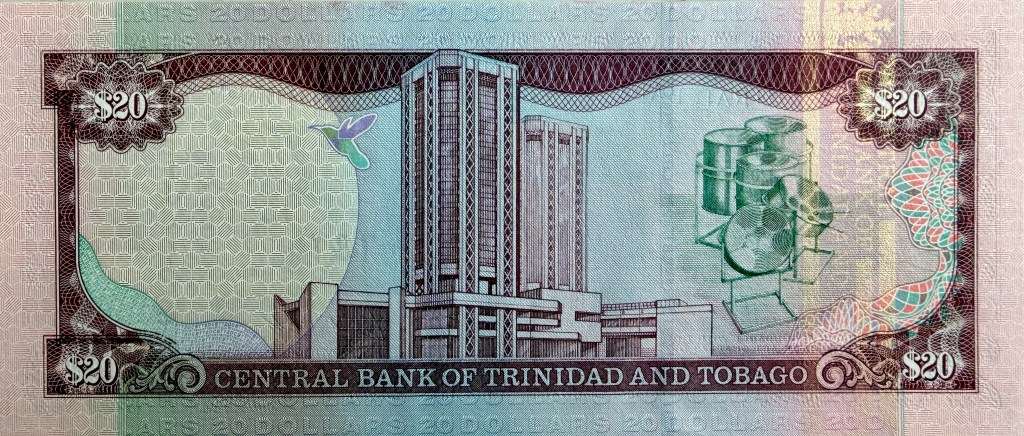
On the back of the note, we see the Eric Williams Financial Complex located in the nation’s capital, Port of Spain. The first tower is home to the Central Bank of Trinidad & Tobago. The second tower is home to the Ministry of Finance. On the right are five steelpans, Trinidad & Tobago’s national musical instrument deeply embedded in the local culture. The registration device of the hummingbird is visible to the left of the towers.
Brazil 1 Real 1994 Series
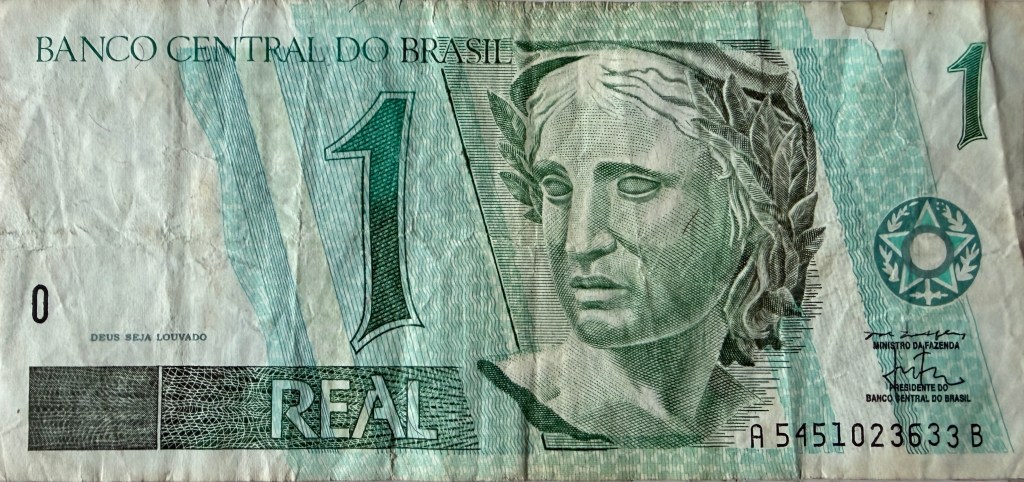
The 1 Real was issued by the Banco Central do Brasil and was the smallest denomination banknote within the 1994 Series. The paper note’s dimensions are 140 x 65 mm. On the face we see the Effigy of the Republic as a sculpture, symbolic of the nation’s personification. A watermark of the effigy sits on the left panel next to an embossed “0”, which helps the visually impaired distinguish the note’s value. The denomination is present in two locations, bookending the effigy.
Adding another layer of security, Brazil’s Coat of Arms appears as a see-through register. It is fully visible only when the note is held up to the light. The partial images printed on both sides of the note then combine to reveal the complete design.

The vertically oriented reverse depicts a phenomenal scene of a Sapphire-Spangled Emerald (hummingbird) feeding its chicks in their nest. The note transforms from its subtle, statuesque front into an animated reverse replete with life. The vignette of the hummingbird feeding its young introduces one of nature’s tender moments, a mother nurturing its chicks.
The Sapphire-Spangled Emerald is endemic to South America and lives in Brazil, Bolivia, Peru, Venezuela and Argentina. Adult birds measure between 8 – 11 cm. The males boast a glittery violet-blue throat distinguishing them from females who have a grayish throat with glittery green spots. Sapphire-Spangled emeralds also feed on nectar and small insects. The two chicks depicted are consistent with the number of offspring these hummingbirds raise at a time. Within 3 – 4 weeks they will be ready to fly on their own.
My Two Cents
Hummingbirds make for remarkable subjects on paper currency. They tell us about their origins, habitats, and natural beauty, serving as windows into a country’s biodiversity and ecological identity. Few creatures capture our attention quite like they do in nature, mesmerizing us with their vibrant plumage and their seemingly impossible flight.
What makes them especially compelling on banknotes is the intentionality behind their selection. Governments and central banks deliberately choose symbols of national pride, natural heritage, and cultural identity. When a hummingbird earns a place on a nation’s currency, it’s a powerful statement about what that country values and wants the world to see. It’s a real treat to see them featured across so many notes and equally rewarding to track them down as part of a collection.


2 responses to “Tiny Wings, Big Bills: Hummingbirds on Paper Money (Part 2)”
Perfect timing Alex! Our backyard has many of these little creatures!
LikeLiked by 1 person
Oh nice! Looking forward to checking them out too.
LikeLike